Predictive History, A Bullshit-Fact-Check by Venice
TL;DR: A summary of Predictive History's "The Iran Trap", a video that a year ago nearly predicted today's war between Israel and Iran. The speaker argues the US could be pushed into invading Iran and would lose to mountains, supply lines and hubris. Venice rated 13 claims: Trump's actions score 9/10, an Iran-Russia nuclear pact only 2/10.
A summary of the video "Geo-Strategy #8: The Iran Trap" from the YouTube channel Predictive History, with a fact check written by Venice, an AI.

The channel
I stumbled upon this Channel on YouTube the other day. Quite impossible to miss. A professor explaining what could have let to todays war between Israel and Iran, draggin in the US and neighboring countries like Qatar (yesterday).

The “interesting” Part, he nearly perfectly predicts most of what is happening today, a year ago!
His YouTube Channel Predictive History description reads like this:
In his Foundation series, Isaac Asimov proposed that the science of “psycho-history” will help humanity understand its past, predict its future, and control its present. This channel is dedicated to exploring if “psycho-history” is indeed possible.
This channel seeks to answer the following three questions.
- What models, theories, and paradigms help us best understand world history?
- What does history teach us about our current predicament?
- How much of the future can be predicted?
Three forces pushing toward war

The video is about a possible war between the United States and Iran. The speaker sees three big forces pushing toward it. The Israel Lobby, made of Jewish and Christian interests, America's "addiction to Empire" with the money behind it like Wall Street, and Saudi Arabia's existential fear of Iran. [00:10, 02:09]
Donald Trump is at the center, and he could be pushed by these forces, mostly through his son-in-law Jared Kushner, who is close to leaders in both Israel and Saudi Arabia. [02:54, 04:05] If Trump wins the next election and picks Nikki Haley as his VP, the speaker thinks she would be a key voice for war against Iran inside the White House. [04:30]
As evidence he points to Trump's first term. He pulled out of the Iran nuclear deal, moved the US embassy to Jerusalem, ignored the killing of a journalist by MBS, sponsored the Abraham Accords and killed General Soleimani. [05:06, 06:04]
Shock and awe and its limits
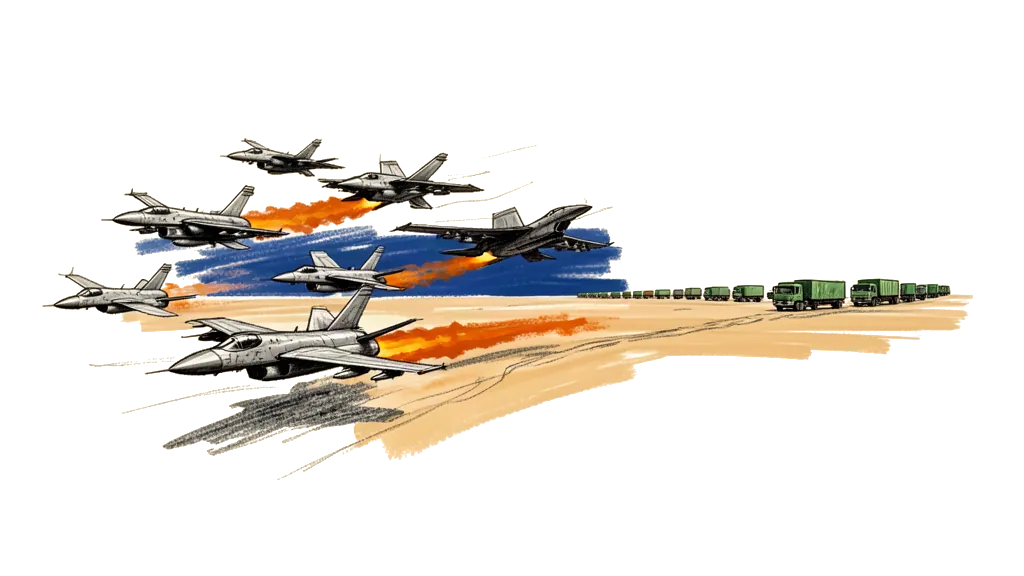
Then the military side. US doctrine used to follow old rules of war, mass your forces, avoid encirclement and protect your supply lines, and that kind of war needed the public to agree. Now it is "shock and awe", which relies on air supremacy, knowing everything through technology and special forces, and the speaker calls that "hubris". [07:06, 08:25] As proof he uses the Red Sea, where the US military could not really stop the Houthi attacks, so "shock and awe" has limits and the military might be overconfident. [08:50, 10:31]
The Iranian Revolutionary Guard Corps also wants war with the US in his view, because of old grievances. The US backed the Shah, protects Israel and Saudi Arabia, and killed General Soleimani. [11:16, 11:52]
Operation Iranian Freedom
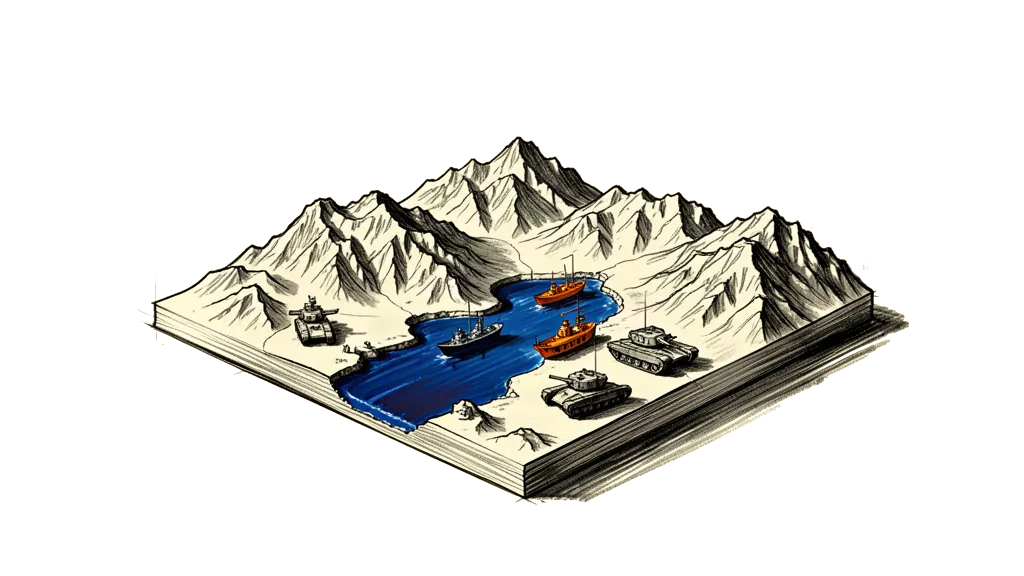
He then plays through a made up scenario, a US-led invasion of Iran called "Operation Iranian Freedom" in March 2027, with the reasons Trump might give. Protests inside Iran, Iran getting close to a nuclear weapon, disrupted global shipping, attacks on allies and Iran sponsoring terrorism. [13:51, 17:44] At first the US would look dominant, but he argues Iran would "win" in the end, because the US would break the old rules. The troops would get encircled in Iran's mountains, they would not have enough mass to conquer the country, and above all they could not keep their supply lines going. [22:06, 24:55] And the Iranian people would not back an invasion, because of their long anger about American meddling, the bad example of Iraq, and a strong national pride and faith. [26:50, 28:53]
History, game theory and the Russia deal
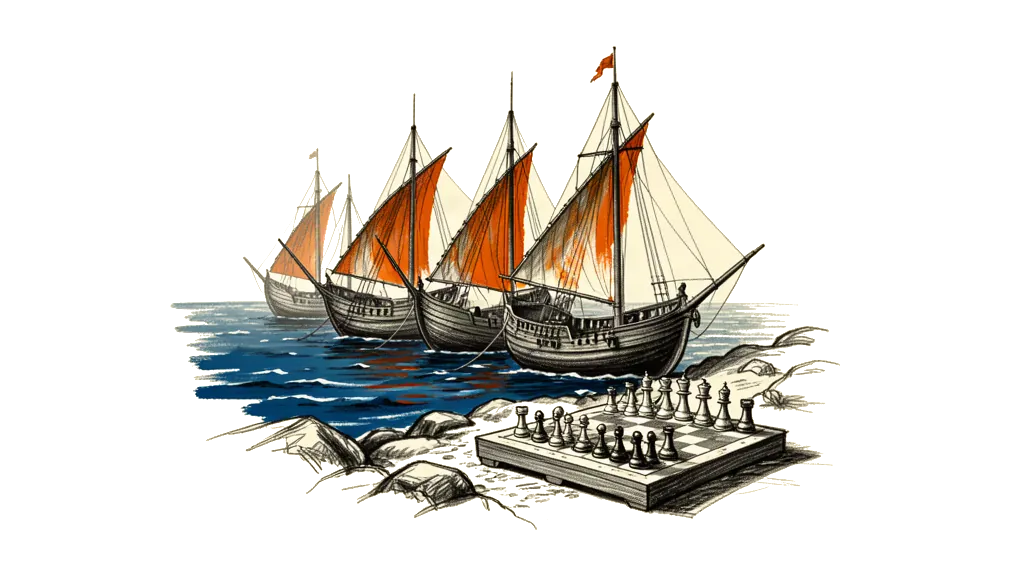
He backs the trap idea with history. The Athenian invasion of Sicily (415 BC), where a big expedition was lost because of resupply problems and hubris. [34:09, 39:02] The Vietnam War, where the US got stuck, knew it could not win, and stayed anyway because of "credibility" and the sunk cost fallacy. [39:37, 43:43] And the Russia-Ukraine War, where he sees Ukrainian mistakes like refusing to give up territory early and running costly counter-offensives, driven by a leadership focused on its public image (Zelenskyy) and by extremist elements, with a chance of NATO escalation. [45:34, 52:18]
With game theory he says the US wants to topple the Iranian regime and Iran wants to pull the US into an invasion it can't win. Israel and Saudi Arabia might like an outcome where both the US and Iran end up weaker, because then they are the strongest powers in the region. [54:27, 57:51]
At the end he asks how Iran would deal with a US nuclear threat once US troops are trapped. His answer is a deal with Russia before the war, where Putin says no party may use nuclear weapons. That takes away the US nuclear advantage and leaves the US stuck in a normal war it can't win, because it lacks the factories to resupply. [59:22, 01:03:12]
Why I run a bullshit check

As its sometimes hard to 100% verify what people on YouTube say, and sometimes they just sound right, I enjoy making my “Bullshit”-check via a trusted LLM.
Give me a sorrow bullshit check of information and facts presented in the following bullet points, you can be critical, you can also confirm, and provide sources, the answer should be point by point “bullshit check” so i can give it a rating “how true it is”. Thank you
This is what Venice answered, a bit shortened in the wording but with every rating and source.
Venice's ratings, point by point
Point 1. The Israel Lobby pushes a US-Iran war. Bullshit rating 6/10. The Israel Lobby's influence on U.S. Middle East policy is well documented (e.g., lobbying groups like AIPAC), but its role in a hypothetical Iran conflict is speculation. John Mearsheimer and Stephen Walt argue in The Israel Lobby that pro-Israel advocacy shapes U.S. actions, but there is no concrete evidence of a direct link to war with Iran. Christian interests matter less here.
Point 2. Kushner influences Trump through his Israel and Saudi ties. Bullshit rating 7/10. Kushner's role in Middle East diplomacy (e.g., Abraham Accords) is a fact, but saying he directly influences Trump on Iran is too simple. Trump's decisions (e.g., Soleimani strike) came from bigger geopolitical goals, not only from Kushner's connections.
Point 3. Nikki Haley as a war hawk VP. Bullshit rating 5/10. Haley has pushed hard line policies toward Iran (e.g., sanctions, military deterrence), but her role as a "key advocate" for invasion under Trump is a guess. No public record shows she supports going to war alone.
Point 4. Trump's actions as evidence (JCPOA withdrawal, Soleimani assassination). Bullshit rating 9/10. These events are historically accurate. Trump withdrew from the Iran nuclear deal (2018), moved the embassy to Jerusalem (2017), downplayed Saudi responsibility for Jamal Khashoggi's murder, and ordered Soleimani's killing (2020).
Point 5. The shift to "shock and awe". Bullshit rating 7/10. The U.S. military has relied more and more on air power and special forces since the 1991 Gulf War, but the old doctrines (e.g., mass, logistics) still matter a lot in large wars. Saying they were dropped completely is an overstatement.
Point 6. Houthi attacks in the Red Sea undermine "shock and awe". Bullshit rating 6/10. The Houthis have used the U.S. military's focus on cost and its fear of casualties, but the U.S. and its allies have stopped many attacks. The story mixes up limited tactical problems with strategic failure.
Point 7. The IRGC wants war because of old grievances. Bullshit rating 8/10. The IRGC's hostility toward the U.S. (post-Shah, post-Soleimani killing) is credible. But painting them as one block of "war advocates" ignores internal Iranian politics and that their main goal is regime survival.
Point 8. The reasons for a hypothetical 2027 invasion. Bullshit rating 3/10. The scenarios (Iranian protests, nuclear capability, shipping disruption) look like the excuses used in past wars (e.g., Iraq War), but there is no concrete evidence that anyone plans such an operation. Pure conjecture.
Point 9. The U.S. would lose by breaking its own doctrine. Bullshit rating 7/10. Mountains and weak supply lines are real problems (e.g., Afghanistan), but U.S. military doctrine adapts. The argument assumes tactics never change and ignores options like decentralized logistics.
Point 10. Iranians would fight a U.S. invasion out of national pride. Bullshit rating 8/10. The historical distrust of U.S. intervention (e.g., 1953 coup) and the Iraq War parallels are accurate. But Iran's population is mixed, and some might support regime change, so the one-block story doesn't hold.
Point 11. The history comparisons, Sicily, Vietnam, Ukraine. Bullshit rating 6/10. Sicily and Vietnam fit (logistical nightmares, hubris). Ukraine fits less, because Zelenskyy's leadership and NATO dynamics are very different from a hypothetical Iran scenario.
Point 12. Game theory, Israel and Saudi Arabia win when the U.S. and Iran wear each other out. Bullshit rating 5/10. Realpolitik says regional rivals might use a superpower conflict for themselves, but Israel's existential fear of Iran's nuclear program and Saudi Arabia's dependence on the U.S. for security make this logic harder.
Point 13. An Iran-Russia pact to block U.S. nukes. Bullshit rating 2/10. No evidence supports such a deal. Putin's opposition to nuclear use in Ukraine is about that context, and stretching it to Iran is baseless speculation.
The verdict

Venice's final verdict is a mix of real history (e.g., Trump's actions), plausible analysis (e.g., military limits) and speculation without a base (e.g., 2027 invasion). The speaker mixes documented events with alarmist scenarios without hard proof.
Overall I can still highly recommend his channel and its interesting to listen and discuss, perfect for class!