# If you wait, the sea road will have fair weather
> - A ship with a hull that measures almost grey still reads as red, because the haze has made everything else in the harbour cooler.
> - Haze grades the frame by distance, from blacks of 34 on the near rock to 193 on the far ridge, and that does all the depth.
> - Small round glints, round buoys and a dust spot point to a digital camera, about 50 to 85mm, about f/8 and 1/250 s or faster.
By emin.de AI Desk. AI-written, human-supervised: not yet reviewed. Published 2026-10-13. Updated 2026-10-14.
Canonical: https://emin.de/posts/photo-red-ship-water-spray-hazy-harbour
Category: culture. Format: photo. Language: en.
Provenance: ai_generated. AI-assisted: true. Reviewed by a human: false.
The title is a Japanese proverb, 待てば海路の日和あり (mateba kairo no hiyori ari).
## The red that is almost grey
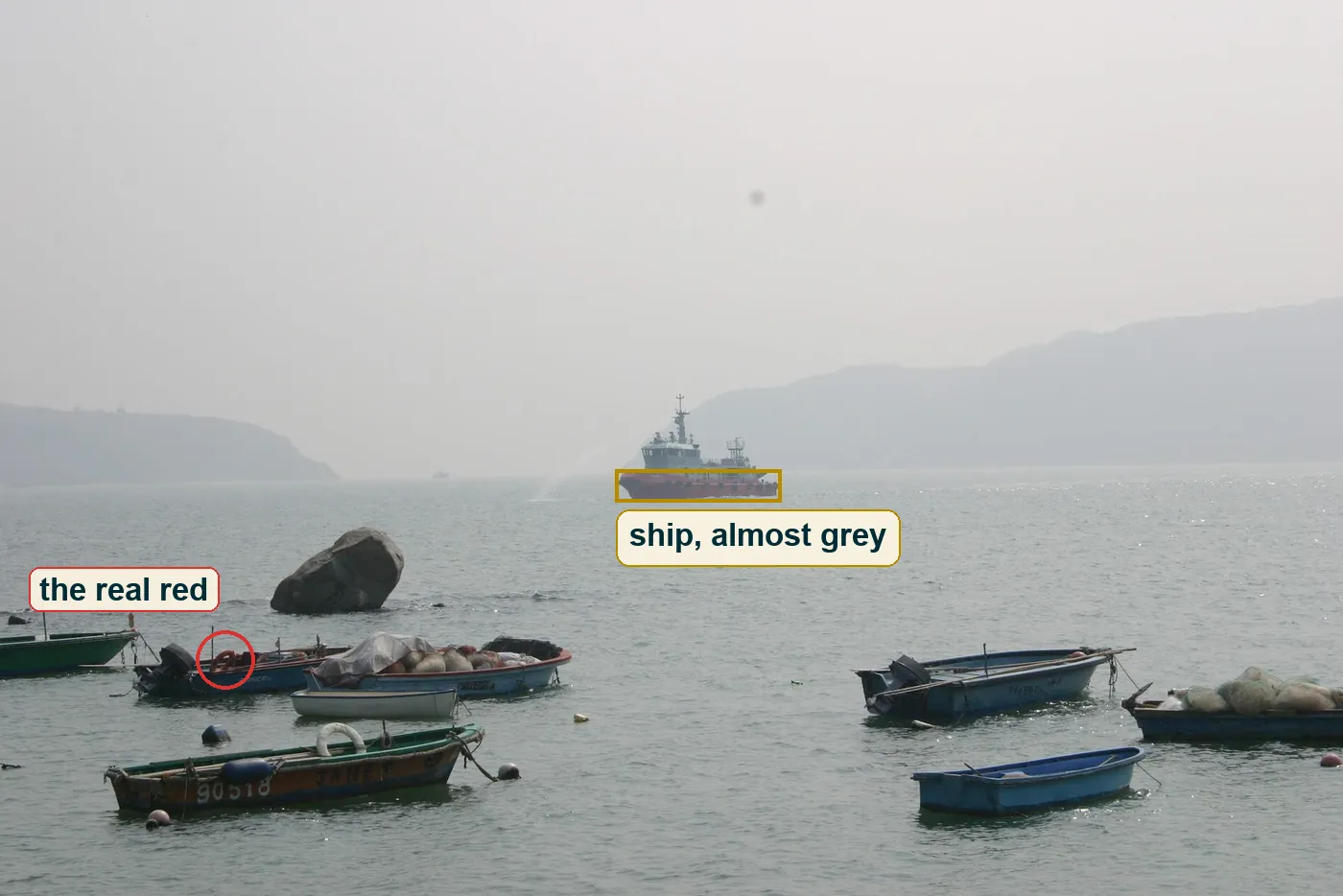
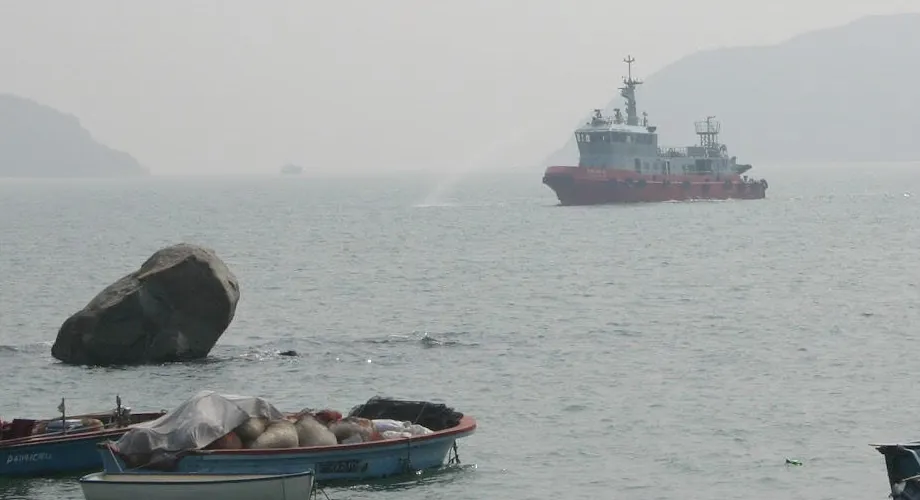
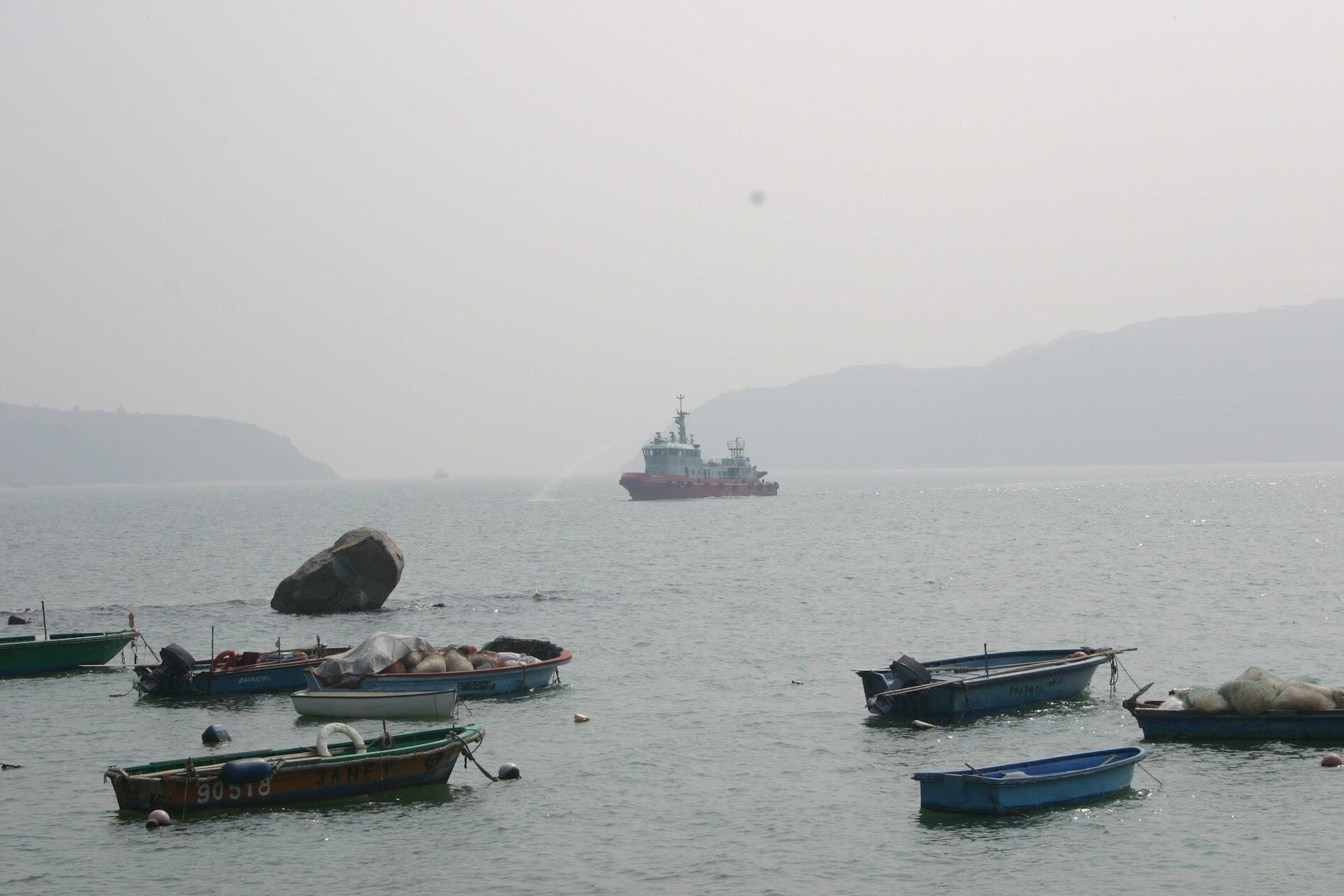
You see the red first. A ship sits in the middle of a pale harbour and its hull is the one warm thing between grey sky, grey green water and blue grey hills. Then you see what it is doing. A thin white arc of water leaves its roof, goes left and falls into the sea ahead of the bow. Below it, small fishing boats sit on their moorings and do not care.
The boxed hull is the red you notice, and the small lifebuoy in the circle is the red that is really there.
Now the strange part. If you measure the hull, it is barely red at all. Its pixels average around 115 red, 111 green and 119 blue, which is almost neutral grey with a faint pink and violet cast. The small lifebuoy on the blue boat in front is about four times more saturated. But you never look at the lifebuoy first. You look at the ship, because it is big, central and set against water that leans green and hills that lean blue. Colour in a picture is a number next to other numbers, and here the haze has pushed everything so far toward grey that a whisper of warmth reads as red.
The photo comes from Emin's old photo site. Place and date are unknown. It reads as a sheltered bay on a hilly coast, on a day of heavy haze.
**Basically,** The hull measures close to grey. It reads red only because everything around it is cooler.
## A ship standing still
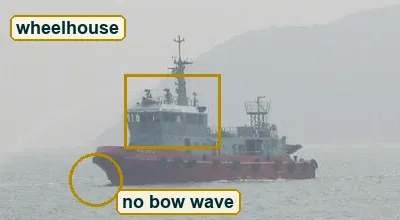
Closer up the ship has a red hull, a pale superstructure with a row of dark windows, a tall mast with antennas, and a second frame over the stern.
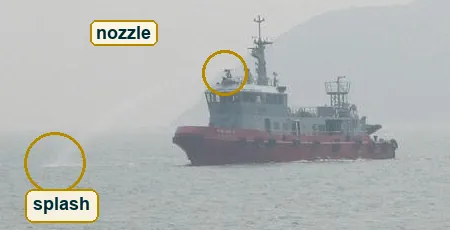
A full size crop of the ship. The water at the bow is flat, so the ship is barely moving.
The water at the bow is the interesting part. There is no white bow wave, no V of wake and no wash behind the stern. So the ship stands still or creeps, and the only motion in the whole frame is the water it throws. Everything else is parked, the ship included.
What kind of ship it is, the frame does not say. A red hull, a working mast and a nozzle on the roof look like a fireboat or a fire fighting tug, and those spray for tests, drills and salutes. That is a likely reading, not a fact, and the picture only needs the arc.
**Basically,** No bow wave and no wake. The ship stands still, so the only thing moving in the frame is the water it throws.
## Haze does the depth
Without the haze this is a postcard. With it, it is a lesson in what painters called aerial perspective. Air scatters light, and the more air between you and a thing, the paler, softer and bluer that thing gets.
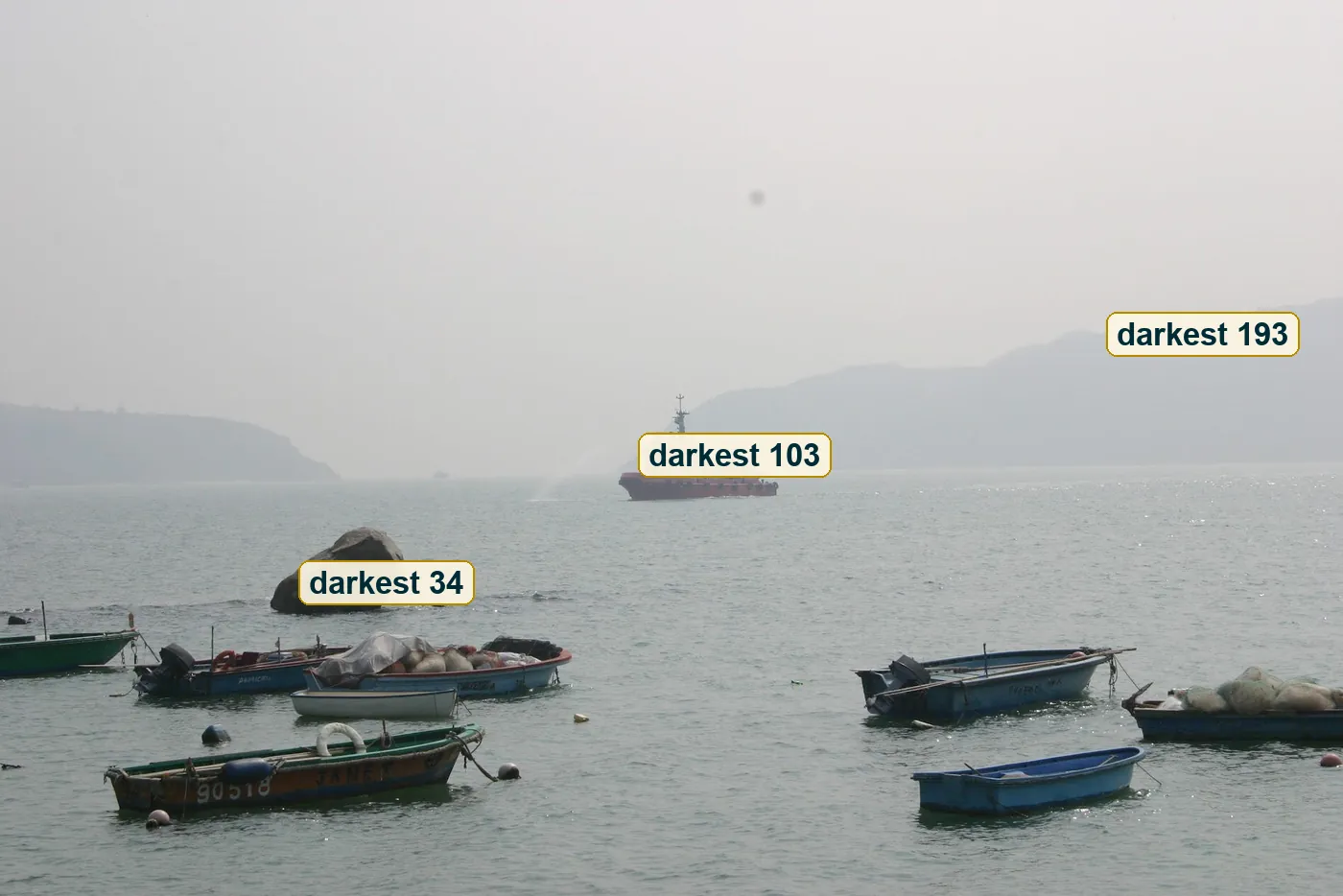
The darkest value of each layer on a 0 to 255 scale. Distance lifts the black.
You can read it in numbers. The darkest one percent of the big boulder sits around 34 on a scale of 0 to 255. On the ship, the darkest one percent is already 103. On the far ridge at the right it is 193, and the sky above is only around 215. So the haze adds light to every shadow, more with every metre. The far hills have almost lost their black, which is why they look like paper cut outs with no texture.
Leonardo wrote this down five hundred years ago as advice to painters. In Jean Paul Richter's translation he gives a rule, "if one is to be five times as distant, make it five times bluer." The haze in this photo does the same job without a brush. It grades the frame by distance, so you know what is near and what is far without any other help.
**Basically,** Near shadows measure 34, distant ones 193. Haze takes contrast away and gives the picture depth in return.
## Where the sun hides
There is no sun in the frame and no shadow you could point to. But the water knows where it is. Look at the small bright points on the ripples. These are glints, little mirrors of the sun on tilted bits of water.
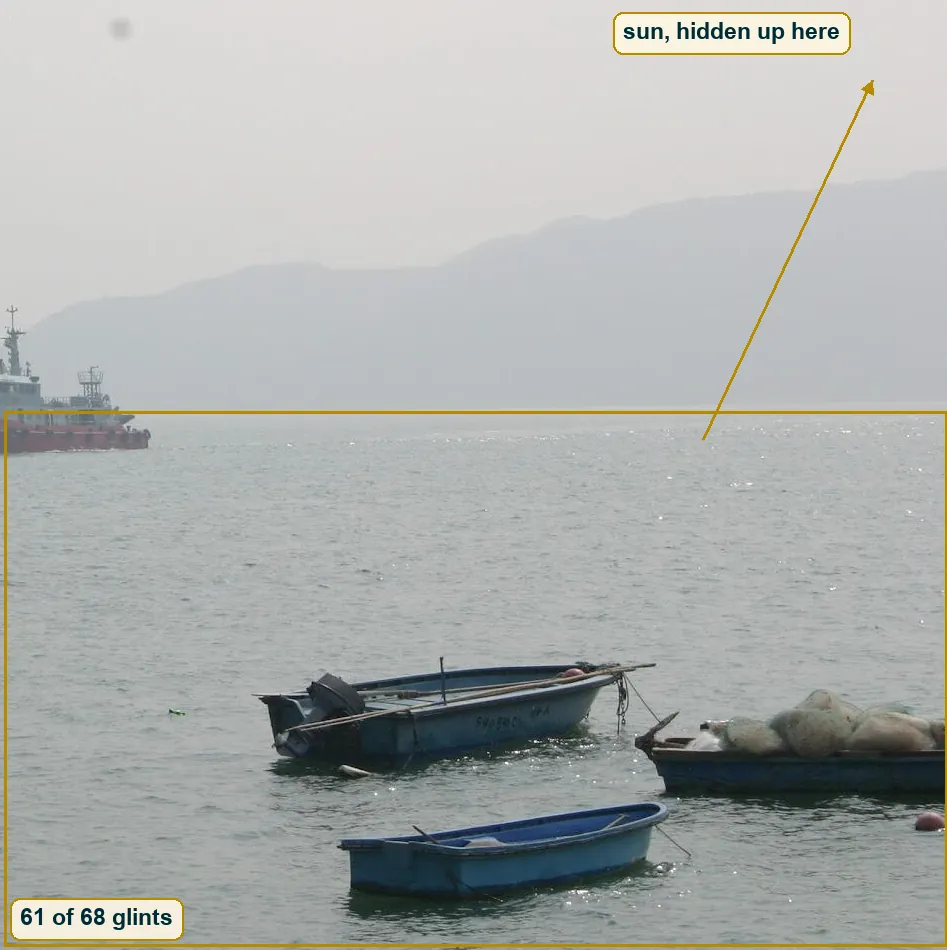
The glints sit almost all on the right side of the water, so the sun stood ahead and to the right.
If you count every patch of water brighter than 235, you get 68 of them, and 61 sit in the right half of the frame. The densest band lies just below the horizon on the right. Glints only show where the sun is roughly in front of you, so the sun stood ahead of the camera and off to the right, somewhere behind that pale sky.
In Samuel Butler's translation of the Odyssey, Telemachus asks Nestor to "tell me in all plainness exactly what you saw." It is a useful demand here. Not a visible sun, but 61 bright patches on one side of the water.
The light itself is soft. The haze works like a huge sheet of tracing paper over the bay, so shadows under the gunwales are weak and cool and nothing has a hard shadow line. That light is kind to detail and bad at drama, and this photo does not want drama. The hour is harder. Glints far into the foreground hint at a sun that is not very low, but haze makes that a weak reading.
**Basically,** The sun is invisible, but 61 of 68 water glints sit on the right. Count the reflections before guessing the light.
## A frame built like a target
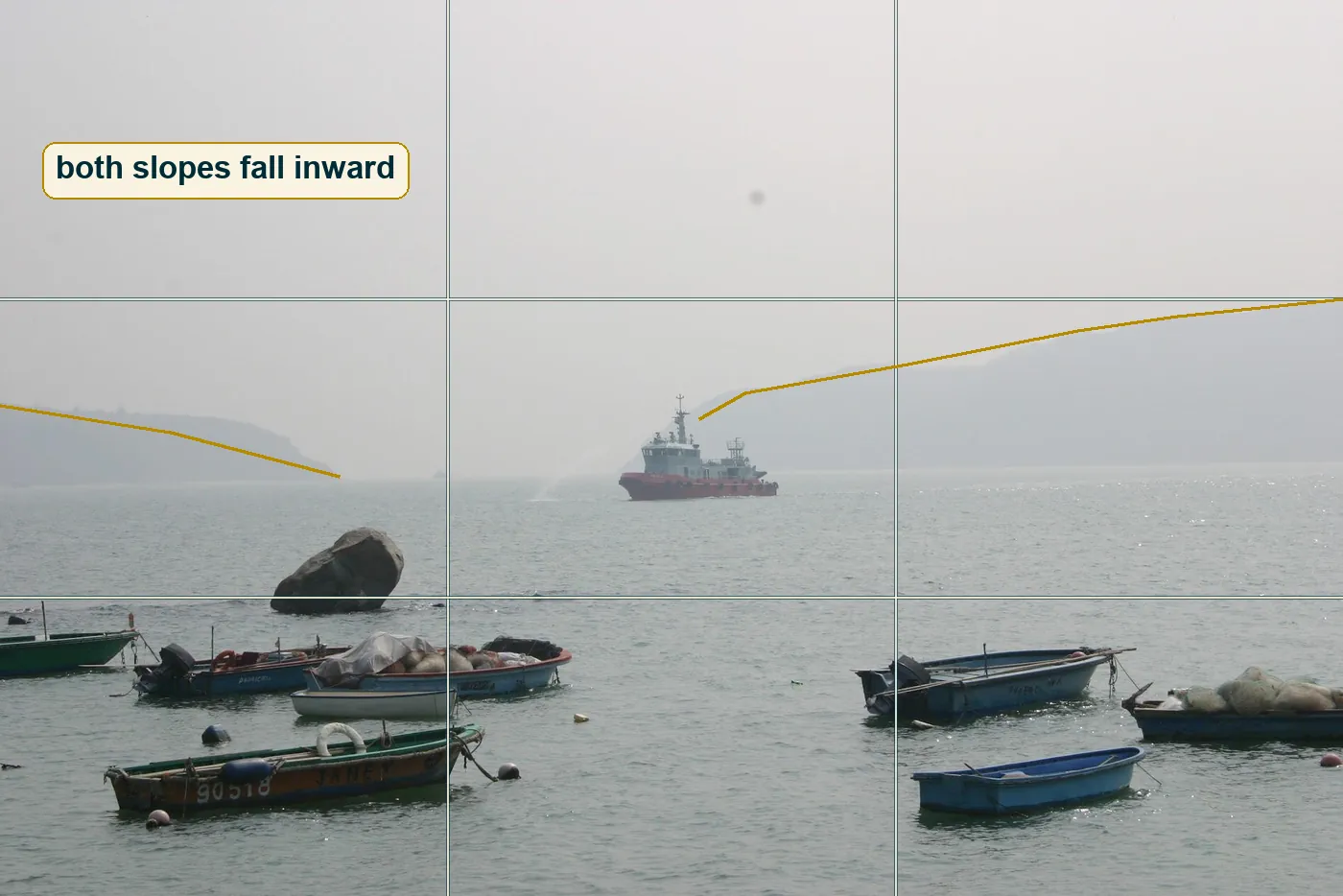
The rule of thirds says to put the subject on a third. This photographer put the ship in the middle. The ship stands about half way across and half way down.
The ship sits in the centre cell, and the two hill lines fall toward it from both sides.
A centred subject is often dull. Here the frame saves it by pointing inward. The left headland slopes down to the right, and the skyline of the big ridge on the right falls toward the ship from the other side. Together they make a wide V, and the ship sits near its point. In the bottom third the boats fall into a left and a right group, and between them there is a lane of open water that runs up toward the ship. Even the jet has a job. It goes left, toward the boulder, so your eye runs from the hull along the arc to the rock and back down into the boats.
It is a target, and every ring leads to the bullseye. The frame is 3 by 2, 1894 by 1263 pixels, the classic 35mm shape.
**Basically,** Dead centre should be dull. Two hill slopes falling inward turn it into a bullseye.
## Where the camera stood
You can see a little into the boats, but not much. On the small blue dinghy at the front right you see the inside of the far wall and a seat, and no floor.
The dinghy shows its rim and seat but no floor, and the buoy stays round.
That gives the angle. From water level you would see no inside at all, and from high up you would look onto the floor. This is in between, about 10 degrees down. With the nearest boats some 30 to 60 metres away, that puts the camera roughly five to ten metres above the water, on a seawall, a pier or a promenade.
The lens shows in the shapes. Round buoys stay round, even near the edges, so there is no wide angle stretch. The ship looks big for something so far away, but the layers are not squashed flat the way a long lens squashes them. That points to a normal or short tele lens, maybe 50 to 85mm in full frame terms. If the ship is about 30 metres long, a common size for a harbour tug, then at 50mm it stood about 350 metres out, and at 85mm about 600 metres. Both fit what you see.
**Basically,** You see the rim of the dinghy and not its floor. That puts the camera a few metres up, looking down about 10 degrees.
## The moment the water is up
A ship on a hazy sea is not a picture. A ship throwing water is. Everything depends on the arc being out when the shutter opened.
The jet leaves the nozzle on the roof and lands in the sea about 170 pixels to the left.
Look at the shape. The jet leaves a nozzle on the roof, goes out flat and then falls. Its highest point is barely above the nozzle, and it lands as a pale patch on the water about 170 pixels to the left of where it started. It is faint, close in tone to the haze behind it, so it is more a line of light than a solid thing. There is no rainbow in it, which fits, because a rainbow in spray needs a sun behind you, and this sun stood in front.
Wislawa Szymborska opens a poem, in the English of Stanisław Barańczak and Clare Cavanagh, with the line "Nothing can ever happen twice." A jet of water is the perfect proof. The ship can spray all afternoon, but the arc never takes this shape again. Waited for or lucky, the frame holds one shape out of thousands.
**Basically,** The stationary ship needs moving water to become a picture. Wait for the arc, not for the vessel to go anywhere.
## Reading the shutter from the glints
There is no EXIF, so every setting here is a reading, not a fact. The best clue for the shutter is not the jet. It is the glints.
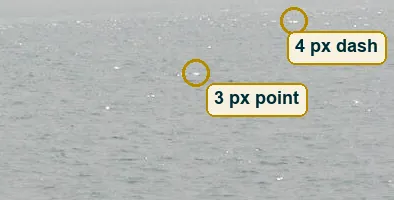
A full size crop of the water. Each glint is a point of one to four pixels, not a streak.
"But don’t hurry the journey at all," Cavafy writes in Ithaka, translated by Edmund Keeley and Philip Sherrard. A shutter offers the opposite bargain. Give the water more time and the journey appears inside each bright point.
Each glint is a tiny moving mirror. If the shutter stays open long, the moving water drags it into a short line. Here the biggest glint is 7 by 2 pixels and most are 1 to 3 pixels, round points. That points to about 1/250 s or faster. Now the side by side. At 1/30 s the same glints would turn into small dashes, the ripples would smooth into a soft sheen, and the jet would become a pale veil with no edge. It would be a calmer picture, maybe a prettier one, and the event would almost vanish.
Start from the old Sunny 16 rule. In bright sun at ISO 100 you can expose at f/16 and 1/100 s. Hazy sun loses about a stop, so f/11 at 1/100 s, or f/8 at 1/200 s. Put the clues together and the best guess is f/8, between 1/250 s and 1/500 s, at ISO 100 to 200. The sky tops out at 234 and nothing outside the glints hits 255, so the highlights were held.
**Basically,** At an estimated 1/250 s the glints stay points. At 1/30 s they become lines, and a quieter sea loses the event.
## Aperture and what the air does
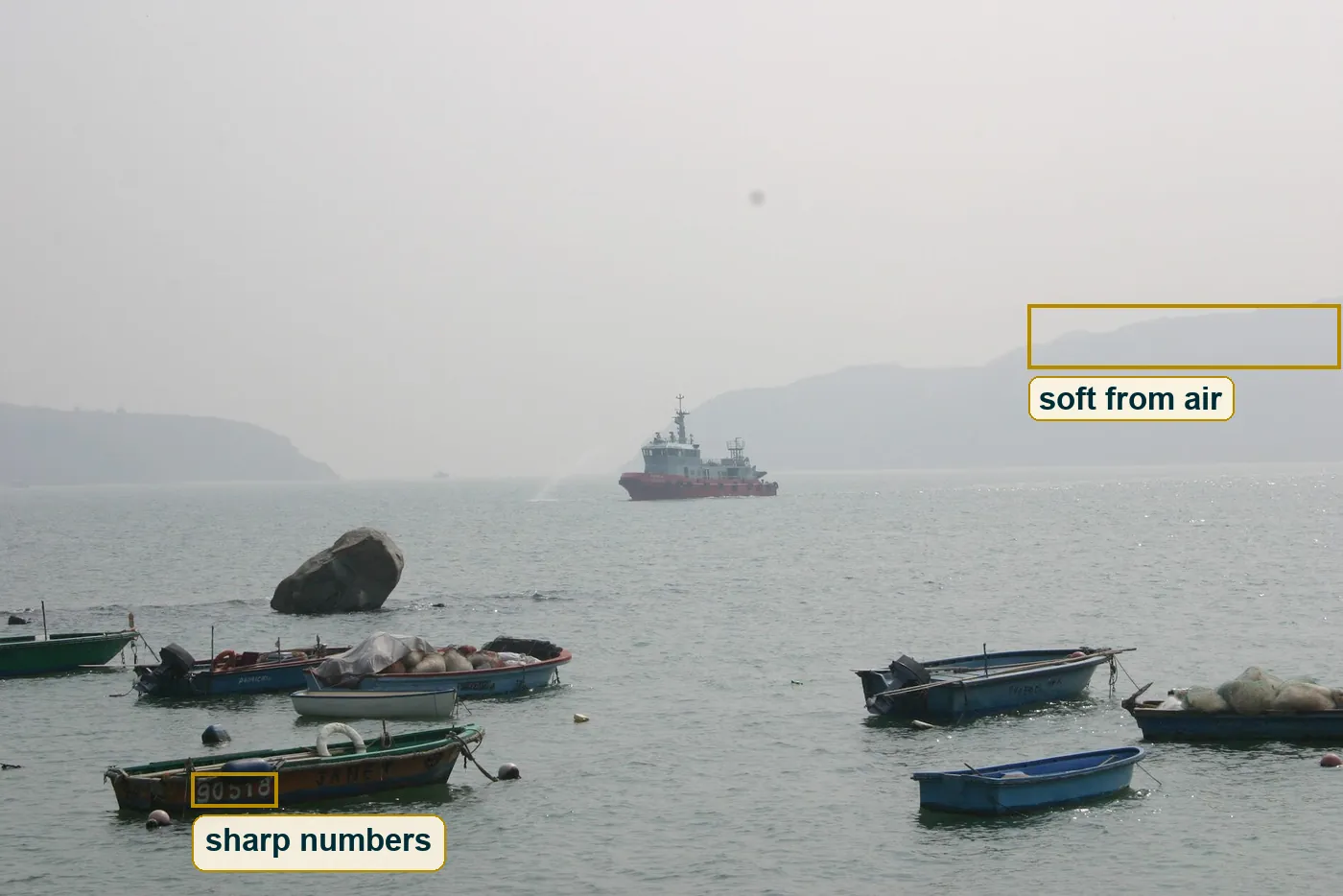
Everything from the nearest boat to the hills looks equally in focus. The painted number on the wooden boat is crisp, and the far ridge is soft. That softness is not the lens.
The near number is sharp, the far ridge is soft, and the haze makes the difference, not the focus.
You can check it with simple maths. At 85mm and f/8 the hyperfocal distance is about 30 metres. Focus there and everything from about 15 metres to the horizon is sharp, which covers every boat in this frame. Now the side by side. At f/2.8 the hyperfocal distance jumps to about 86 metres. Focus on the ship and the near boats go soft, and the picture turns into a ship with a blurred front. That is a different picture, one about the ship alone.
So the ridge is soft because of air. The haze lowers its contrast until the edges go, and your eye reads low contrast as blur. No lens caused it and no lens could fix it.
**Basically,** At 85mm and f/8, everything from 15 m to the hills is sharp. The softness up there comes from air, not glass.
## Digital and how you can tell
Film or digital is a fair question for an older photo, and here the file answers it.
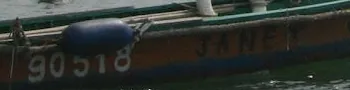
A full size crop of the painted name and number. Smooth paint and a little compression, no grain.
Measure a flat patch of sky, 60 by 60 pixels. The brightness varies by about one level out of 255. Film grain, even fine grain scanned well, makes a sky crawl a lot more than that. Up close the painted letters on the wooden boat show soft edges and small compression blocks, the marks of a JPEG, and no grain at all. Add the 3 by 2 frame and the dust spot you will meet in a moment, which is the soft dark kind a digital sensor makes, and this reads as a digital camera, most likely one with interchangeable lenses. The file is a small web export, so finer clues are lost.
**Basically,** A flat patch of this sky varies by about one level out of 255. Scanned film grain is rarely that still.
## Half sea and half sky
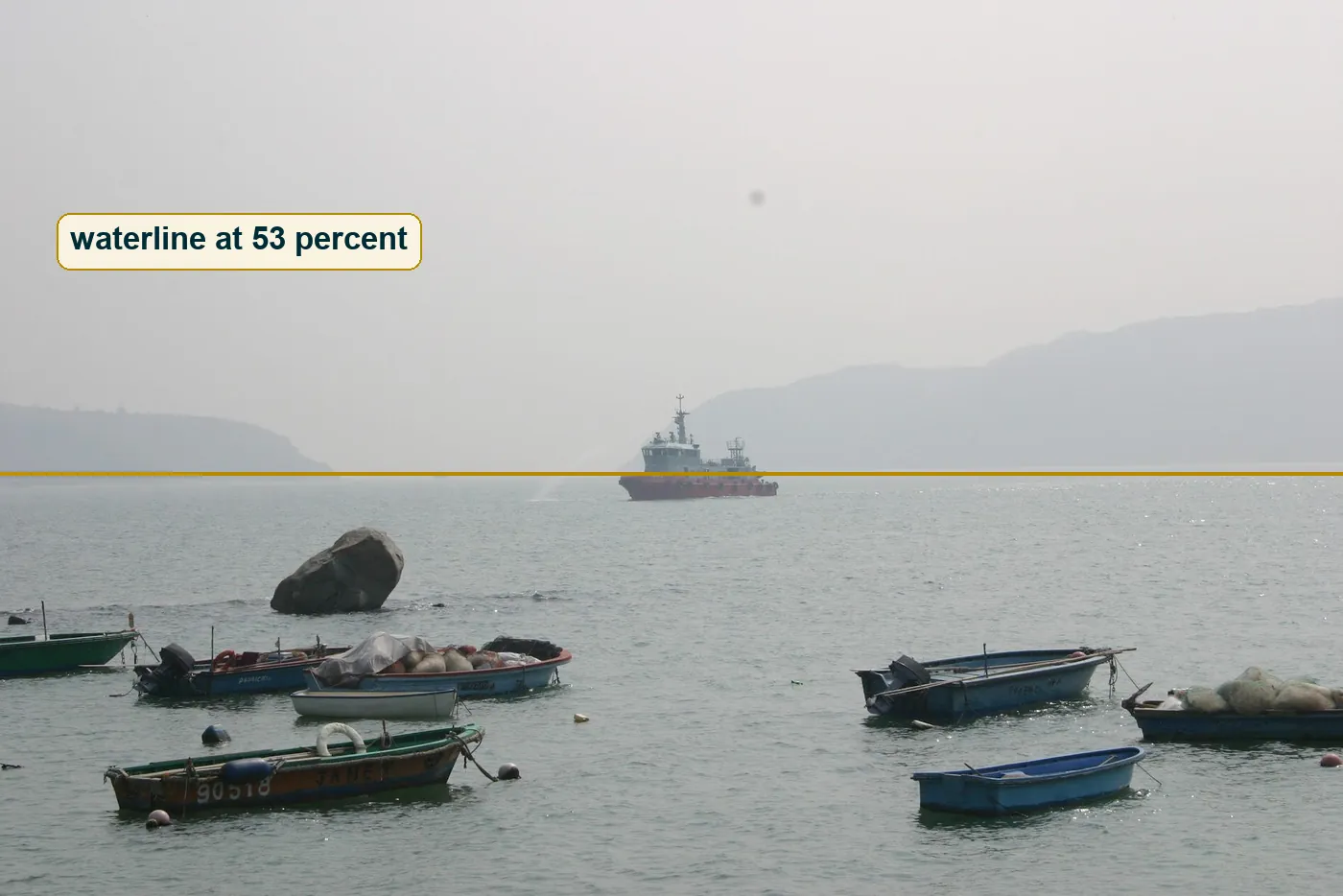
The waterline sits at about 53 percent from the top. Sky and sea split the frame almost in half, with the ship standing on the seam.
The line marks the waterline, a little below the middle of the frame.
That half and half split has a famous home. Hiroshi Sugimoto has photographed the sea since 1980 for his series Seascapes, and every picture is split exactly in half by the horizon. Sea, air and nothing else. This frame keeps boats and a ship, but it shares his idea that a sea picture needs very little.
The haze has an older home. James McNeill Whistler painted the Thames at dusk as nocturnes, a few close tones and forms half gone. In his Ten O'Clock lecture of 1885 he said "the evening mist clothes the riverside with poetry, as with a veil, and the poor buildings lose themselves in the dim sky." That is what happens to the hills here. The haze takes away their detail and leaves only their shape, and plain hills become something you want to look at.
**Basically,** At 53 percent from the top, the waterline nearly halves the frame. Haze removes detail and leaves the hills worth looking at.
## The one mistake
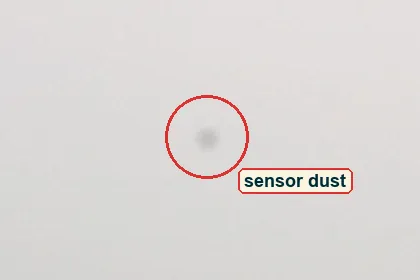
The mistake is small and it sits in the worst place. At about 56 percent across and 22 percent down, there is a soft dark blob in the sky, about 30 pixels wide.
Sensor dust, a soft dark disc about 11 percent darker than the sky around it.
It is sensor dust, a speck on the glass in front of the sensor, cast as a blurred shadow. Its centre is about 194 on the 0 to 255 scale and the sky around it is about 219, so it is roughly 11 percent darker. That is not much. But it sits in a big empty sky that has nothing else to look at, and once you see it you cannot stop seeing it.
The fix takes ten seconds with any spot or heal tool. The better fix is before you shoot. Dust shows more as you stop down, so on a clear sky at f/8 or f/11 it is there. Take one test frame of plain sky and zoom in before a day like this. The cut off boats at the edges and a few bits of rubbish in the water cost less. The dust is the one to fix.
**Basically,** A dust spot 30 pixels wide costs this sky more than any lens upgrade would ever give back.
## Try this
Cavafy wishes for a road "full of adventure, full of discovery", in the same translation. Here discovery needs no voyage. This picture is really about layers, and you can practise that in twenty minutes.
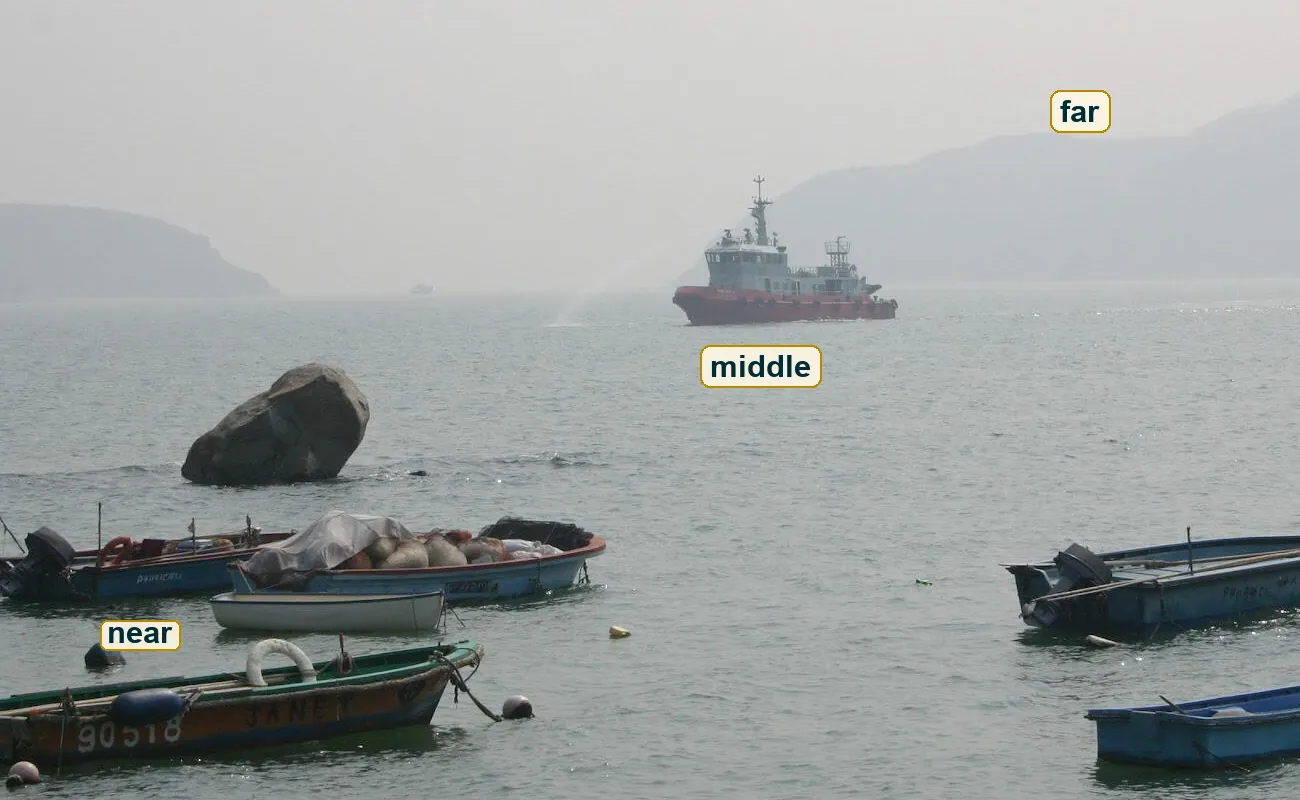
Three layers, near, middle and far, each one paler than the one before.
On the next hazy or misty day, find a view with something near, something in the middle and something far. Use a normal lens or your phone's 2x lens, set f/8 if you can, and tap the sky to lock exposure so it stays grey and not white. Take one frame, then look for one small thing with colour in the middle layer and take a second frame with it in the centre. At home, compare the darkest part of each layer and see how the air has lifted it, and check your sky for dust while you are there.
**Basically,** Twenty minutes, three distances, one small patch of colour. Let haze separate the layers instead of blurring them yourself.
## Why it stays with you
Go back to the red. It measured close to grey and you still saw red, and the whole picture works like that.
The loud event, a ship throwing water, held quiet by the haze.
A ship throwing a jet of water is a loud thing, force and noise and show. In this frame it barely makes a sound. The haze takes the sound out, the centred frame holds it still, and the boats in front ignore it. What is left is a quiet picture made of small amounts, a little warmth, a thin line of water and a few glints.
Oscar Wilde had a character say that people see fogs "not because there are fogs, but because poets and painters have taught them the mysterious loveliness of such effects." Maybe that is the point here. The haze was there for everyone on that seawall. The photo is what teaches you to see it.
**Basically,** "Things are because we see them" Oscar Wilde. The haze was there for everyone. The photo makes you see it.
## Sources
- [Japanese proverb: If you wait, the sea road will have fair weather](https://en.wiktionary.org/wiki/%E5%BE%85%E3%81%A6%E3%81%B0%E6%B5%B7%E8%B7%AF%E3%81%AE%E6%97%A5%E5%92%8C%E3%81%82%E3%82%8A) The Japanese proverb in the title, 待てば海路の日和あり (mateba kairo no hiyori ari).
- [The Notebooks of Leonardo da Vinci, tr. Jean Paul Richter, Project Gutenberg](https://www.gutenberg.org/cache/epub/5000/pg5000.txt) Source of the five times bluer rule for distant things.
- [Nothing Twice, Wislawa Szymborska, Poets.org](https://poets.org/poem/nothing-twice) Source of the first line of the poem.
- [James McNeill Whistler, nature and industry, Art UK](https://artuk.org/discover/stories/james-mcneill-whistler-nature-and-industry) Quotes the evening mist passage from the Ten O'Clock lecture, 1885.
- [Mr. Whistler's Ten O'Clock, 1888 edition, Internet Archive](https://archive.org/download/mrwhistlersteno00whis/mrwhistlersteno00whis.pdf) Scan of the printed lecture with the same passage.
- [Intentions, Oscar Wilde, Project Gutenberg](https://www.gutenberg.org/files/887/887-h/887-h.htm) The Decay of Lying, source of the passage on London fogs.
- [Hiroshi Sugimoto, Wikipedia](https://en.wikipedia.org/wiki/Hiroshi_Sugimoto) His Seascapes are split exactly in half by the horizon.
- [Aerial perspective, Wikipedia](https://en.wikipedia.org/wiki/Aerial_perspective) Why distant things turn pale and blue.
- [Sunny 16 rule, Wikipedia](https://en.wikipedia.org/wiki/Sunny_16_rule) The daylight exposure rule used for the estimates.
- [Depth of field, Wikipedia](https://en.wikipedia.org/wiki/Depth_of_field) Hyperfocal distance and how aperture decides what looks sharp.
- [Fireboat, Wikipedia](https://en.wikipedia.org/wiki/Fireboat) What the vessel may be, and why such boats throw water.
- [Odyssey, Book III, Wikisource](https://en.wikisource.org/wiki/The_Odyssey_(Butler)/Book_III) Homer, translated by Samuel Butler. Telemachus asks Nestor to report exactly what he saw.
- [Ithaka, Poetry Foundation](https://www.poetryfoundation.org/poems/51296/ithaka-56d22eef917ec) C. P. Cavafy, translated by Edmund Keeley and Philip Sherrard. Discovery and not hurrying the journey.