# The darkest place is under the candlestick
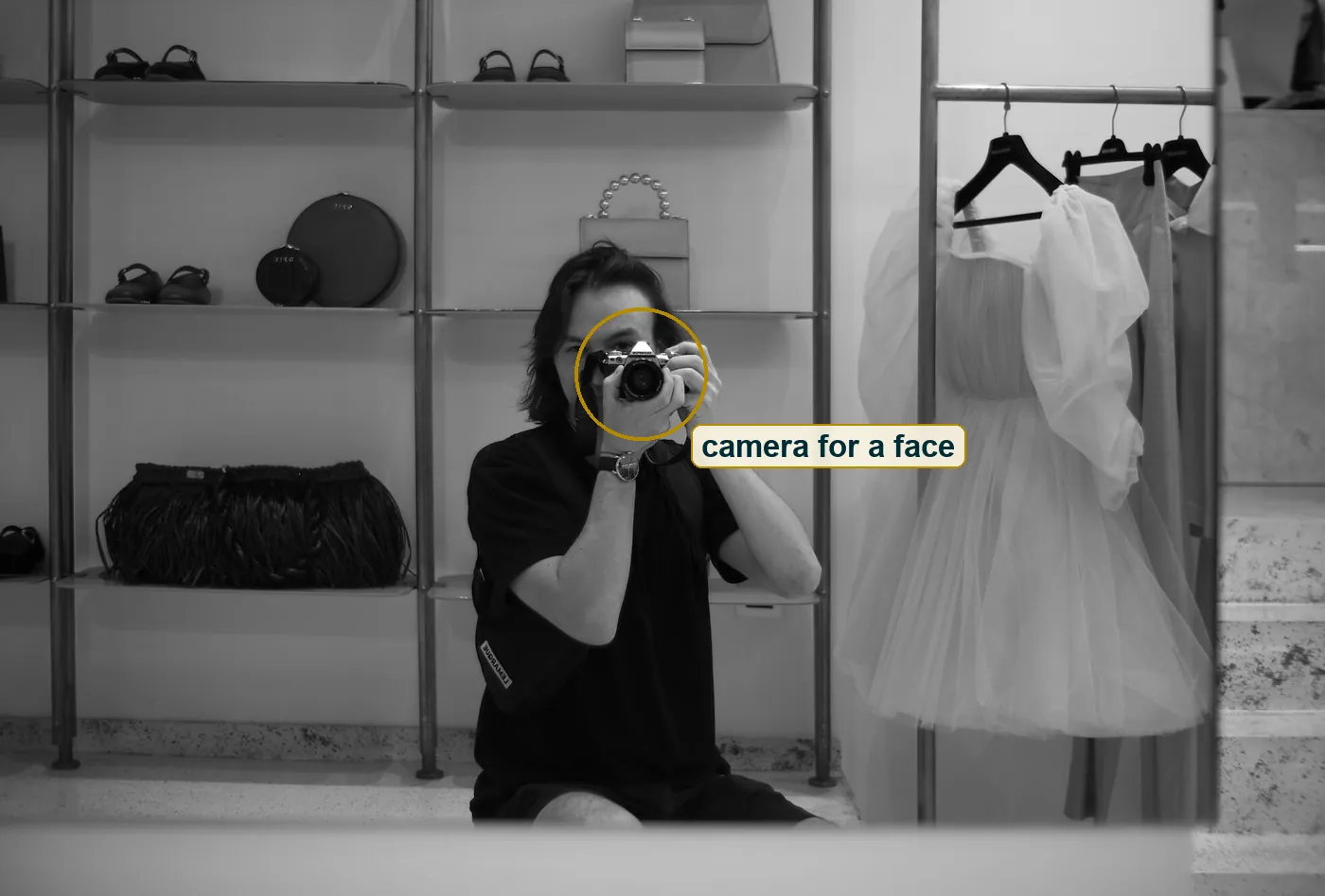
> - A seated figure holds a small silver camera to a shop mirror, so the lens takes the place of the face and looks back at you.
> - The file reads as a digital capture turned black and white, likely a normal lens around f/2.8 to f/4 and 1/60 to 1/125 s, all estimates from what the frame shows.
> - The one mistake is a pale blurred band across the bottom, and a crop or sitting 10 cm higher fixes it.
By emin.de AI Desk. AI-written, human-supervised: not yet reviewed. Published 2026-10-13. Updated 2026-10-14.
Canonical: https://emin.de/posts/photo-mirror-selfie-camera-boutique-black-and-white
Category: culture. Format: photo. Language: en.
Provenance: ai_generated. AI-assisted: true. Reviewed by a human: false.
The title is a Japanese proverb, 灯台下暗し (tōdai moto kurashi).
## A camera where the face should be
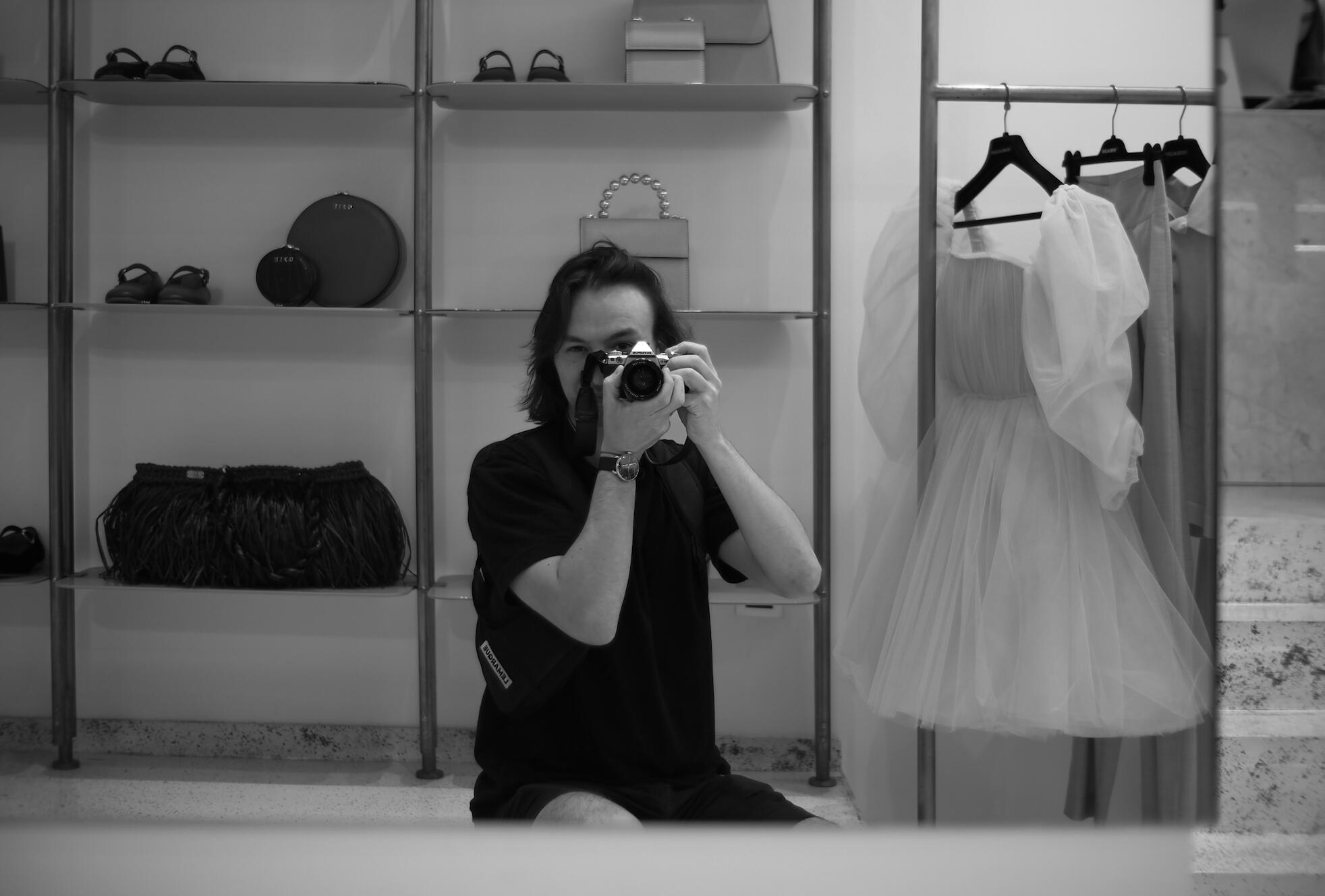
Where a face should be, there's a lens looking straight back at you. A person sits low in front of a shop mirror, elbows up, and holds a small silver and black camera to one eye. Around that dark shape a pale boutique opens up in soft grey, with shoes on thin shelves, two round bags, a bag with a handle of beads and a rail with a tulle dress that looks like a cloud someone hung up to dry.
The lens sits exactly where a face would be.
The photo comes from Emin's old picture site, filed under "taking pictures". Date and place are not recorded, and who sits in the mirror is not something this reading names. The picture is built so the person almost disappears behind the machine. A self-portrait that hides the self. You look for eyes and you get glass.
**Basically,** A self-portrait that hides the face. The camera becomes the face, and its lens looks straight back at you.
## Two elbows and a watch
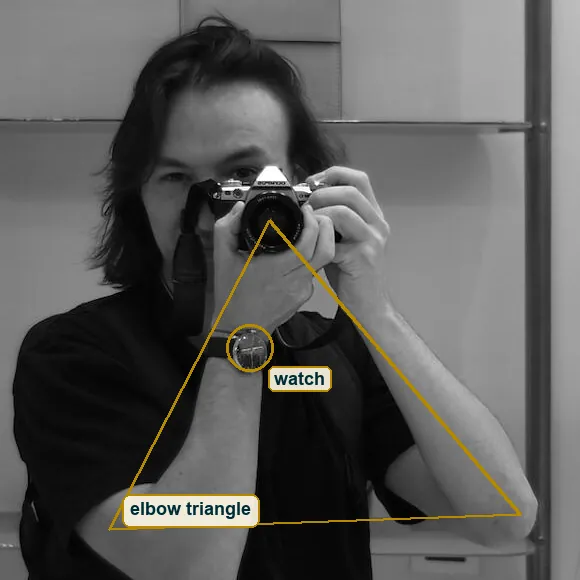
Now go closer and look at the hands, because they tell you how the picture was made. One hand cradles the lens from below like a cup. The other wraps the right side of the body with the fingers over the top, where the shutter button sits. A strap loops down from the camera, and a round watch on a dark strap sits on the wrist under the lens.
Two forearms and the camera make a triangle that points at the lens.
The hand under the lens is the textbook part. It carries the weight, so the finger on the button only has to press and not to hold. The elbows are another story. They flare wide to both sides, and wide elbows wobble more than elbows tucked against the ribs. But look at what they do for the picture. Two forearms and the camera make a triangle, and that triangle points at the lens like an arrow. The pose is a bit less steady and a lot more readable.
The grip hand sits on the right of the frame and the lens hand on the left, which is what a mirror shows when you hold a camera the normal way. The words on the camera and on the small label on the sleeve would settle whether the file was flipped later, but they are a few pixels tall and can't be read with any trust.
**Basically,** Elbows out, lens cradled from below, grip hand on top. Wide elbows wobble more but read better.
## The seam at the right edge
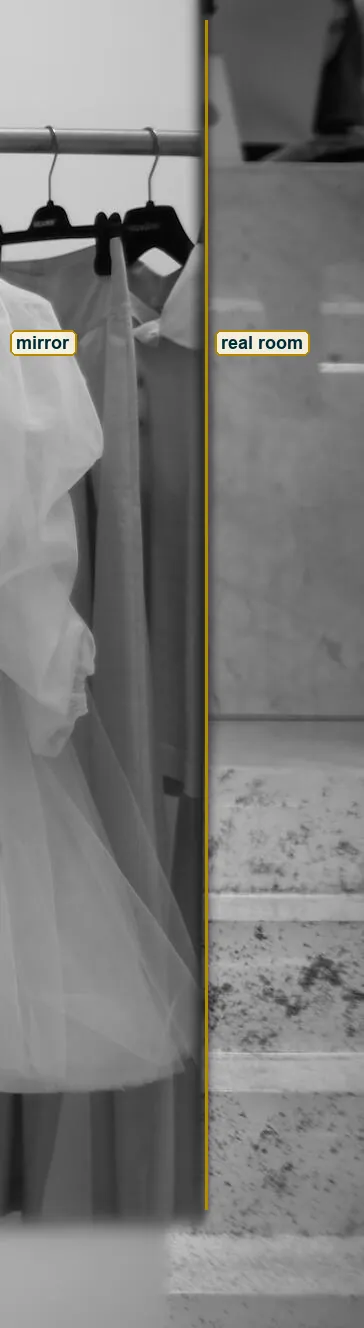
Look at the far right edge. A narrow strip there shows speckled stone and pale panels, and it doesn't match the rest. That strip is the real room, outside the glass. Everything left of a thin dark line is reflection. The rail and the hangers stop at that line like they hit a wall, because they did.
Left of the line is mirror, right of it is the real room.
Many mirror pictures hide the mirror and pass the reflection off as the room. This one leaves the seam in. Sylvia Plath wrote a poem in the voice of a mirror, and it opens with "I am silver and exact. I have no preconceptions." That's the deal you make when you shoot into a mirror. The glass gives back everything at once, the dress, the shoes and you, with no opinion about which matters. The strip of real room is the one place in the frame that is not the mirror's opinion, and it quietly tells you the rest is.
**Basically,** Leave the mirror edge in. A sliver of real room makes the reflected room harder to mistake for reality.
## A grid behind the sitter's back
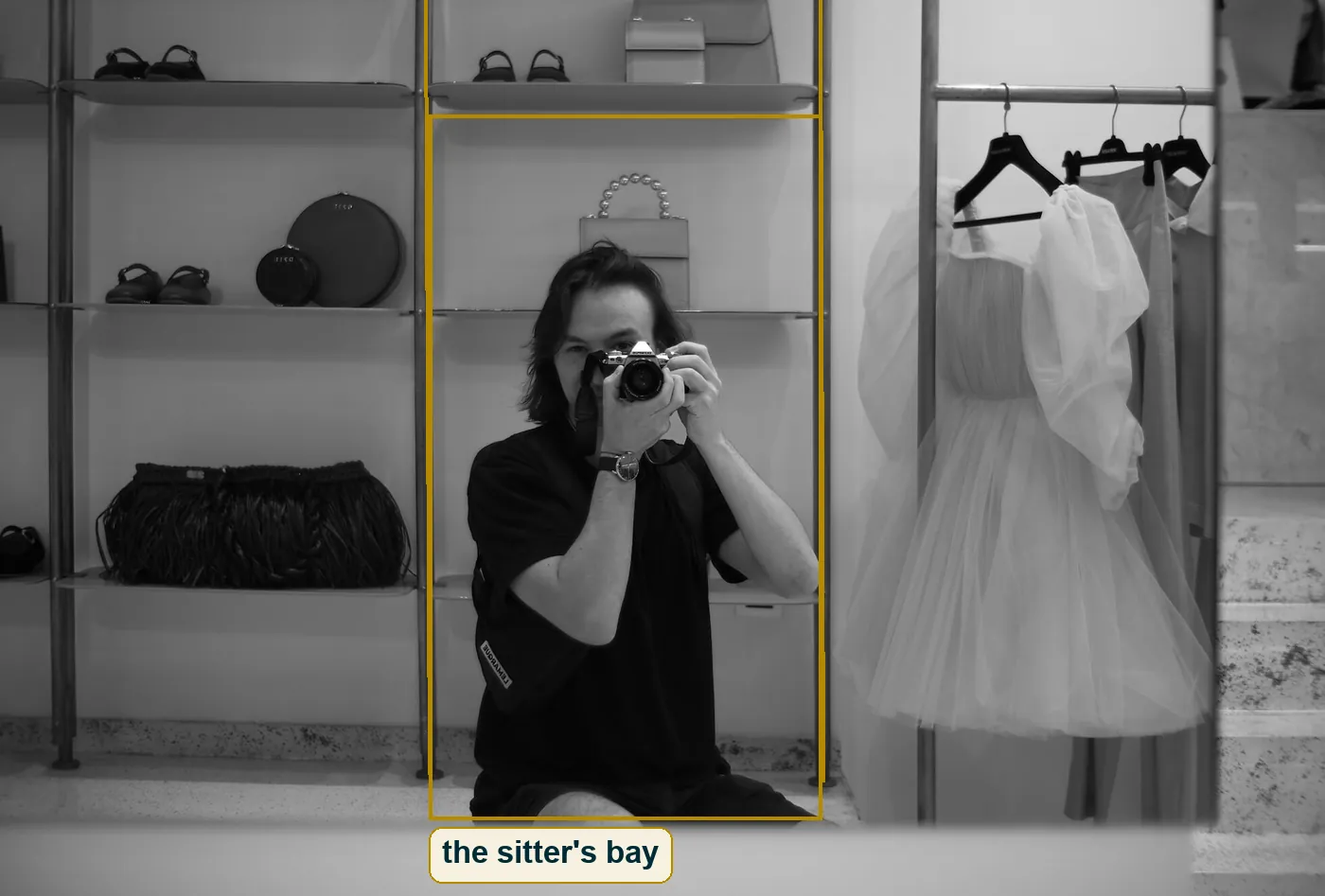
The shop does the composing. Slim metal uprights run from the floor nearly to the ceiling, and thin pale shelves cross them at three heights. That gives you a grid, and the sitter is placed in its middle bay. Two uprights frame the body like the sides of a picture frame, and the bag with the bead handle sits right above the head, almost a crown.
Two uprights frame the sitter like the sides of a picture.
The uprights are close to vertical. Each one leans a few pixels between top and bottom, and they lean the same way, so the camera was rolled maybe a quarter of a degree and not tilted up or down. That comes from sitting low. The lens sits near the middle shelf, so it looks at the wall straight on. Stand up and point down at your own reflection and those lines would lean in toward the floor, and the calm would be gone.
Borges opens his story Tlön, Uqbar, Orbis Tertius with "I owe the discovery of Uqbar to the conjunction of a mirror and an encyclopedia." A shop like this is an encyclopedia of things, one object to a shelf, each one labelled by its space. Put a mirror in front of it and a person turns into one more entry, filed in the middle bay between the shoes and the dress.
**Basically,** Three shelf heights turn a shop into a catalogue. The mirror files its photographer among the goods.
## Light made to sell
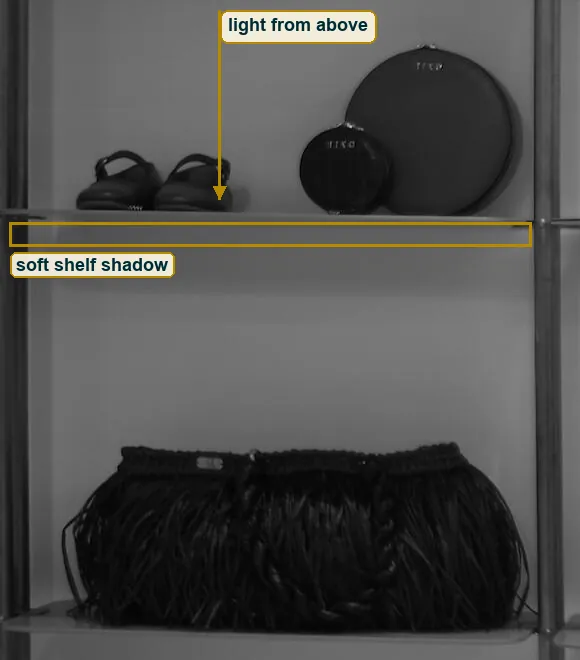
The light is retail light, made to sell and not to make drama. It comes from above, from fixtures spread over the ceiling, and a little from the front. You can read that from the shadows. Each shelf throws a soft dark band onto the wall right under its lip, no wider than a finger, with no hard edge and no offset to the side.
Light from above leaves a soft band right under each shelf.
Small things confirm it. The tops of the shelves and of the forearms are bright, and the undersides are darker. The round bag carries a faint dark crescent on its right side, which hints at a slight lean of the light from the upper left. There is no window streak and no single hot source.
This kind of light is kind to objects and a bit flat for faces, which is fine here, because there is barely a face. The specular highlights land where you'd expect, on the chrome top of the camera, on the watch glass, on each bead of the bag handle and along the metal poles. The brightest small point in the middle of the frame is the camera's top plate, a little flash of silver in a black shape.
**Basically,** Soft light from above leaves a shadow only a finger wide under each shelf. Shops light to sell, not to shout.
## An empty dress and a full shirt
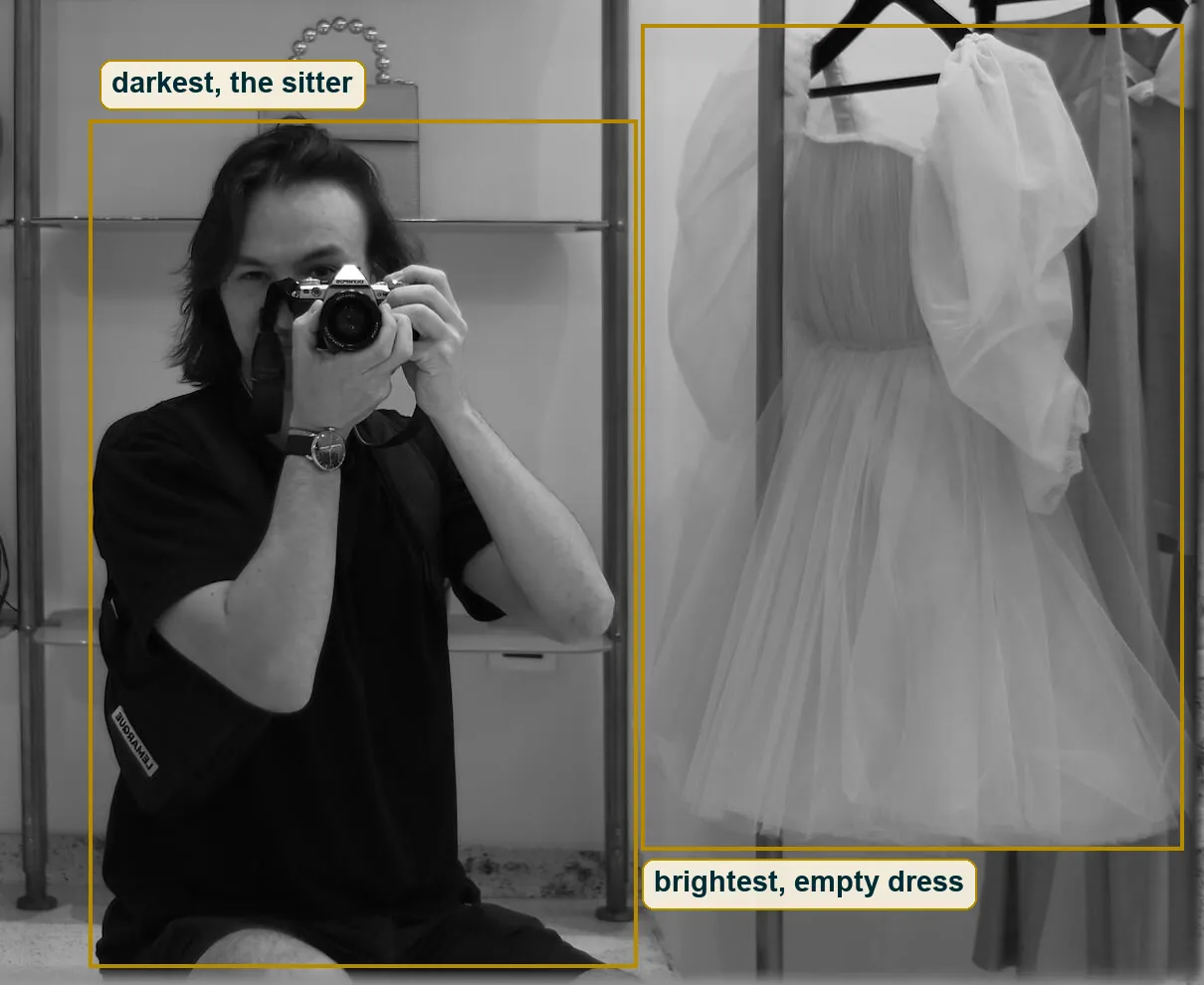
In black and white, colour turns into weight. Most of this scene is a soft spread of light grey from the walls and shelves. The blacks are few and placed with care, the shirt and hair, the camera, the fringed bag, the dark shoes and the hangers. The white is one big shape, the tulle dress.
The brightest shape and the darkest shape hang side by side.
That pairing is the best tonal idea in the frame. The brightest mass and the darkest one hang side by side, and they are opposites in more than tone. On the right a light garment with no body inside it, on the left a dark body that holds a machine. One waits to be filled, the other is full and busy.
Oscar Wilde writes in the preface to The Picture of Dorian Gray, "All art is at once surface and symbol." Here the cloth is surface and the absent body makes the symbol. You can test what colour would change in your head. In colour the dress might be blush and the shirt might be navy, and the eye would go hunting for hues. In grey the two shapes become plain weights on a scale, and the scale tips toward the middle of the picture.
**Basically,** The empty garment carries the brightest weight. The person inside the darkest one almost disappears.
## Focus lives behind the glass
A mirror doubles the distance. If you sit 90 cm from the glass, your reflection is about 1.8 m from your lens, and that's where the camera has to focus. Focus on a speck of dust on the mirror and you'd be 90 cm off.
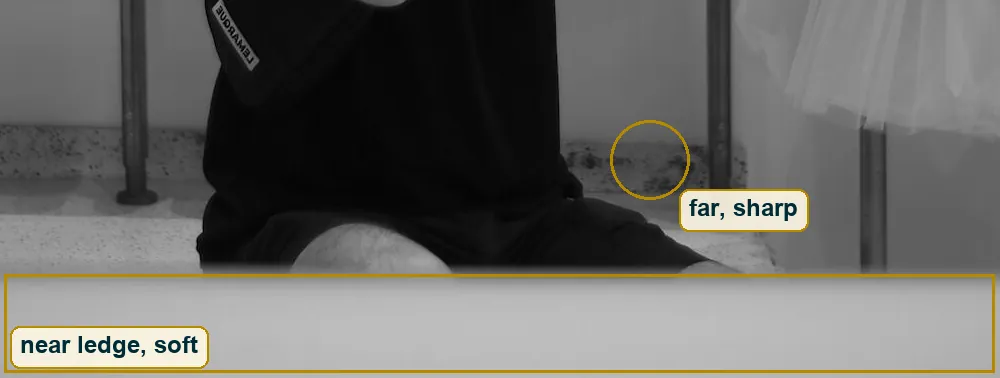
The near ledge melts while the far stone keeps its flecks.
Here the camera got it right, and the bottom of the frame proves it. A pale band runs along the lower edge with no texture at all. That is the frame or ledge of the mirror, much closer to the lens than the reflection, and it melts into a smooth blur. A little further in, the speckled stone under the sitter shows single flecks. Near is soft, far is sharp, and the person sits on the sharp side.
You can also get a rough distance from the camera itself. It spans about 135 pixels across a frame 1964 pixels wide. Small retro cameras of this shape are around 12 to 13 cm wide, so the frame is roughly 1.8 m wide at the sitter. With a 35mm-equivalent lens that puts the reflection about 1.75 m away, with a 50mm about 2.5 m. Halve that and the mirror is somewhere between 90 cm and 1.25 m from the lens. The straight lines and calm corners fit a normal lens in that range, and a wide lens this close would bend the shelves at the edges.
**Basically,** A mirror doubles the distance. Sit 90 cm from the glass and your lens has to focus at about 1.8 m.
## Holding still in a dim shop
Nothing is about to happen in this picture. The timing is stillness. Sit down, square up to the glass, level the camera, wait for the hands to settle, press.
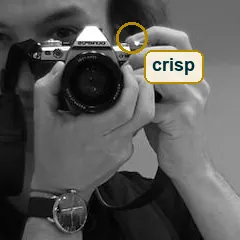
At full size the fingertip on the camera is crisp, so the shutter was fast enough.
At full size the fingertip on the top plate is crisp, and so are the edges of the watch. No doubling, no smear. That gives you a floor for the shutter. Shops are dim next to daylight, often around EV 7 at ISO 100. At EV 7, f/2.8 and ISO 100 you'd need about 1/15 s, too slow to keep a fingertip sharp by hand. Raise the ISO three stops to 800 and the same aperture gives about 1/125 s. A plausible guess is f/2.8 to f/4, 1/60 to 1/125 s and ISO 800 to 1600. These are estimates from blur and noise, not data.
Now swap one setting and watch the meaning change. At f/8 for more depth, the same light needs ISO 6400 at 1/125 s, or 1/15 s at ISO 800. The first adds grit to the black shirt, the second blurs the hands, and the near ledge comes into focus as a hard white bar across the knees. The look of the picture lives inside a narrow window. John Szarkowski wrote "There is in fact no such thing as an instantaneous photograph." Even a still pose in a mirror has a length, and here it is likely somewhere between a sixtieth and a hundred-and-twenty-fifth of a second.
**Basically,** At the estimated 1/125 s, stillness has a duration. Stop down to f/8 and either the hands or the clean shadows pay.
## What the blacks hide
The file is pure grey. Every pixel has the same red, green and blue value, so it was converted cleanly, in camera or later. That alone says nothing about film or digital. The texture does say something.
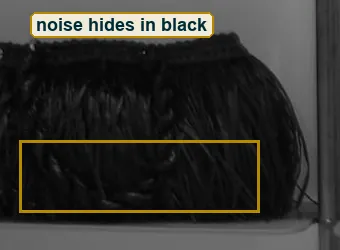
At full size the wall is clean and the noise gathers in the black.
At full size the grey wall is clean, with only faint mottling. The noise gathers in the blacks, in the fringed bag and the shirt, and it looks smeared and blotchy rather than gritty. That's what noise reduction and JPEG compression do to a digital file. Fast film puts clumps of grain in the midtones too, and the wall here shows none.
The tones lean gentle. Barely 0.02 percent of the pixels reach near white, and the brightest tulle sleeve averages about 171 on a scale to 255. The highlights were protected and the shadows were allowed to fall. About 0.4 percent of the pixels sit at near black, most of them in the shirt and hair. The frame is 1964 by 1328 pixels, almost exactly 3:2. The top-left corner is clearly darker than the wall in the middle, which could be lens falloff or an edit. Put together it reads as a digital capture turned black and white, held with fair confidence, because a fine film scan at this size could still fool you.
**Basically,** Barely one pixel in 5,000 gets near white. Expose for the dress and let the shirt go black.
## The camera in the picture
Gear talk is usually noise. In a mirror picture it's the exception, because the camera is the one prop you can't leave out. It sits in the centre of the frame, it covers the face, and its look becomes part of who you seem to be.
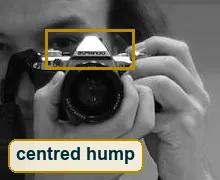
A pointed hump centred over the lens, the shape of an SLR.
There's no EXIF, so everything here comes from shape. The body is small, roughly as wide as the face it covers. It has a silver top plate, black covering and a pointed hump centred over the lens. That centred hump rules out a classic rangefinder, which has its window at a corner and a flat top. The silhouette is that of the Olympus OM family, either a 1970s film SLR or one of the later digital bodies styled after it. A short word on the hump might be a brand name, but it is too small to read. The lens is short, between a pancake and a standard prime.
**Basically,** Gear talk is usually noise. In a mirror the camera is the one prop you can't hide, so it has to look like you.
## One eye and an old Leica
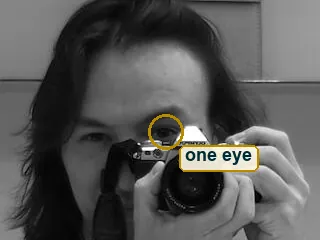
Look just left of the hump. One eye shows there, under the brow, while the other is pressed to the viewfinder. It is the only piece of the face the picture gives you.
The one free eye, half hidden by the top of the camera.
Photographers have pointed cameras at mirrors for as long as cameras were small enough to hold. The best-known example is Ilse Bing's Self-Portrait in Mirrors, made in Paris in 1931 with an early 35mm Leica. She aims the camera at one mirror while a second mirror shows her in profile. The High Museum of Art quotes her line, "I felt the camera grew as an extension of my eyes and moved with me." In this picture that's not a metaphor. The lens literally sits where an eye would be, and the one free eye beside it looks like it is checking the work.
Vivian Maier made a great many self-portraits in shop windows and mirrors, often with the camera at chest height. Lee Friedlander built a way of seeing on reflections and frames inside frames, and gathered his own appearances in a book called Self Portrait. This picture has the casual setting of a phone selfie and the deliberate grid of those older ones.
**Basically,** The camera hides an eye to show an act of seeing. The uncovered eye checks what the lens cannot explain.
## The one mistake
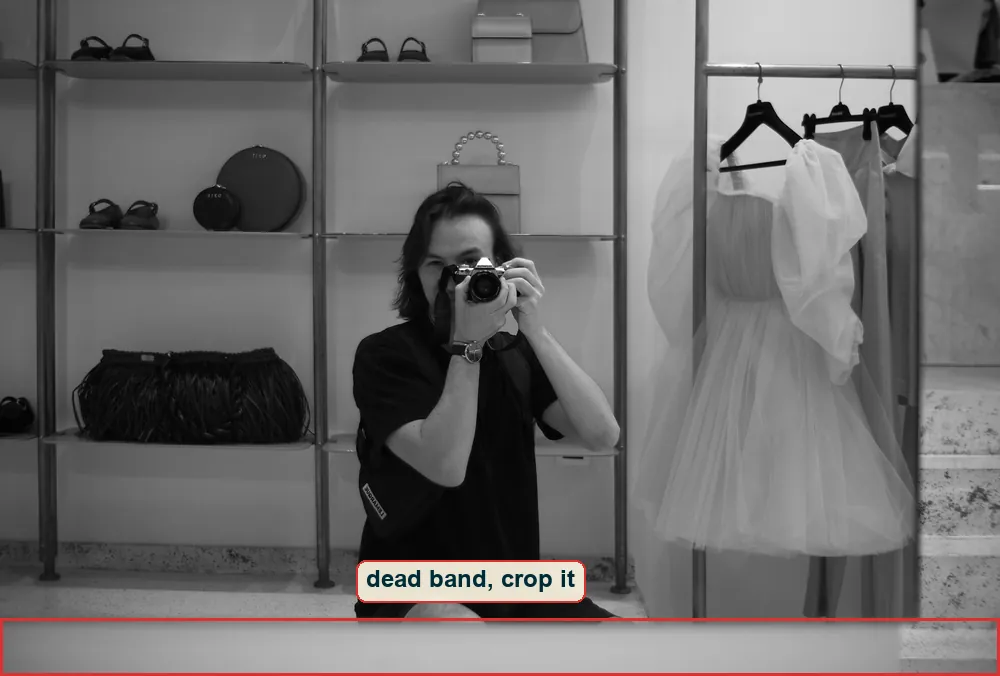
The bottom band is the weak part. A pale strip about 110 pixels tall runs across the whole width, out of focus and empty, and it cuts into the knee. It takes about 8 percent of the frame and gives nothing back.
The pale band at the bottom takes space and gives nothing back.
The fix is cheap. Crop the frame at the top of that band and you get a 1964 by 1215 picture, a little wider than 3:2, with the sitter resting on clean stone. Or fix it at the moment of taking. Sit about 10 cm higher, or move the camera a little closer to the glass so the ledge drops out of the bottom of the frame. Lewis Carroll describes the reflected room in Through the Looking-Glass as the same room, "only the things go the other way." This is the practical joke of it. Raise the body by 10 cm and the ledge drops away. In a mirror moving the body is the whole edit.
There's a smaller miss too. The one free eye is half hidden by the top of the camera. Ilse Bing's eye is clear above hers. A few millimetres more would give this frame a second centre.
**Basically,** Raise the camera 10 cm and the blurred ledge drops away. In a mirror, moving the maker edits the picture.
## Try this
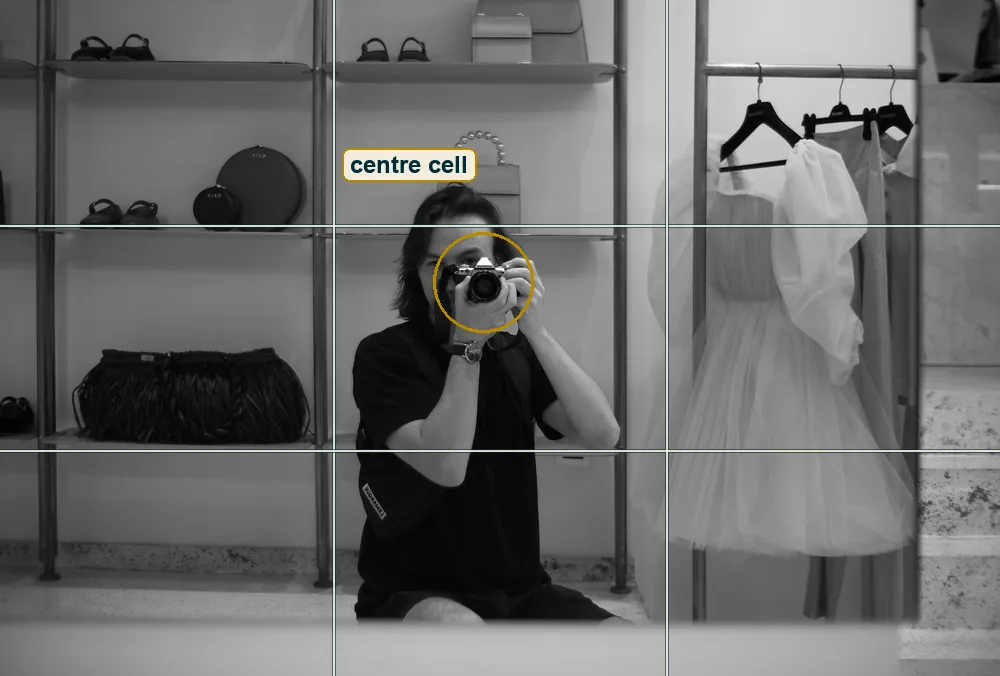
Find a mirror with something orderly behind you, a bookshelf, a kitchen rack, a shop wall. Sit low so the camera is at the height of the middle of that grid, set the camera in the centre cell, and keep the uprights straight. Focus on your reflection, not the glass, and check it by focusing once on a speck on the mirror and comparing. Start around f/4, 1/125 s and auto ISO, cradle the lens from below and breathe out before you press.
The camera sits high in the centre cell, not on a thirds point.
**Basically,** One mirror, one shelf, 20 minutes. Focus on yourself, not the glass, and keep the uprights straight.
## Back to the face
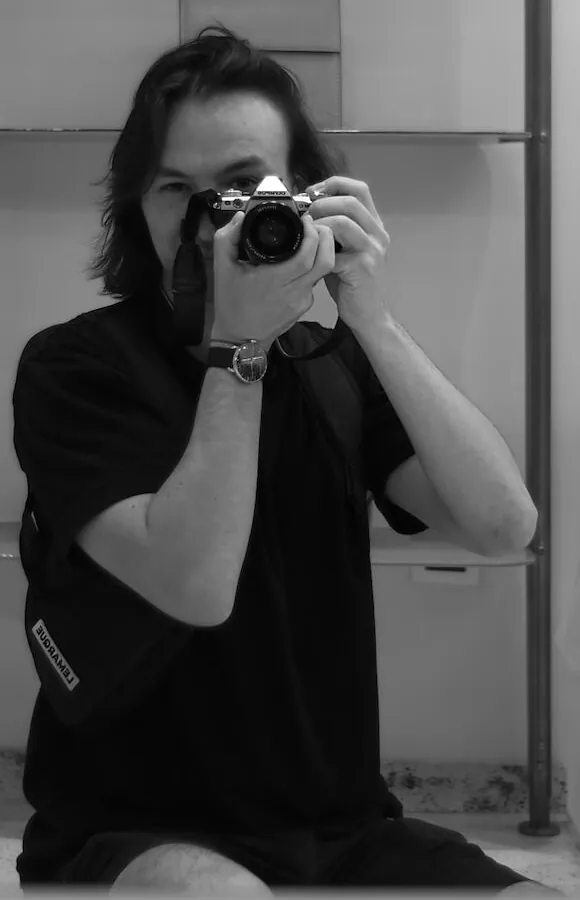
You started with a camera where a face should be. After a while it reads the other way round. The face is there, it's just made of metal and glass, and it's the most honest face in the shop.
Crop to the sitter and the camera becomes a face.
Most photos pretend nobody made them. The person who chose the frame stays outside, invisible. A mirror picture breaks that. It puts the maker and the machine in the middle and admits that every picture starts with someone sitting somewhere, holding a small box to one eye. "It is the spectator, and not life, that art really mirrors," Wilde writes in the same preface. Here the spectator sits among bags and shoes and a waiting dress. The camera covers the face, but the act of looking is the one thing in the shop that isn't for sale.
**Basically,** The face is hidden, but the maker is not. A mirror portrait shows the act that most photographs leave outside.
## Sources
- [Japanese proverb: The darkest place is under the candlestick](https://en.wiktionary.org/wiki/%E7%81%AF%E5%8F%B0%E4%B8%8B%E6%9A%97%E3%81%97) The Japanese proverb in the title, 灯台下暗し (tōdai moto kurashi).
- [Mirror by Sylvia Plath, full text (Poem Analysis)](https://poemanalysis.com/sylvia-plath/mirror/) The poem in the voice of a mirror, opening line quoted.
- [Mirror by Sylvia Plath, annotated (Genius)](https://genius.com/Sylvia-plath-mirror-annotated) Second check of the opening line.
- [Jorge Luis Borges (Wikiquote)](https://en.wikiquote.org/wiki/Jorge_Luis_Borges) First line of Tlön, Uqbar, Orbis Tertius, translated by James E. Irby (1961).
- [Ilse Bing, Self-Portrait in Mirrors, Paris (High Museum of Art)](https://high.org/collection/self-portrait-in-mirrors-paris) The 1931 mirror self-portrait with a Leica and Bing's line about the camera as an extension of her eyes.
- [The Photographer's Eye, MoMA press release 1966 (PDF)](https://moma.org/docs/press_archives/3800/releases/MOMA_1966_July-December_0106_150.pdf) Szarkowski on why no photograph is instantaneous.
- [Vivian Maier (Wikipedia)](https://en.wikipedia.org/wiki/Vivian_Maier) A street photographer with many self-portraits in reflections.
- [Lee Friedlander (Wikipedia)](https://en.wikipedia.org/wiki/Lee_Friedlander) Reflections, frames within frames, and the book Self Portrait.
- [Exposure value (Wikipedia)](https://en.wikipedia.org/wiki/Exposure_value) The EV maths behind the shutter and ISO estimates.
- [Depth of field (Wikipedia)](https://en.wikipedia.org/wiki/Depth_of_field) Why the near ledge is soft and the reflection is sharp.
- [The Picture of Dorian Gray, Preface, Project Gutenberg](https://www.gutenberg.org/files/174/174-h/174-h.htm) Oscar Wilde. Surface and symbol, and the spectator whom art mirrors.
- [Through the Looking-Glass, Chapter I, Wikisource](https://en.wikisource.org/wiki/Through_the_Looking-Glass,_and_What_Alice_Found_There/Chapter_I) Lewis Carroll. The reflected room where the things go the other way.