The player is lost, the onlooker sees clearly
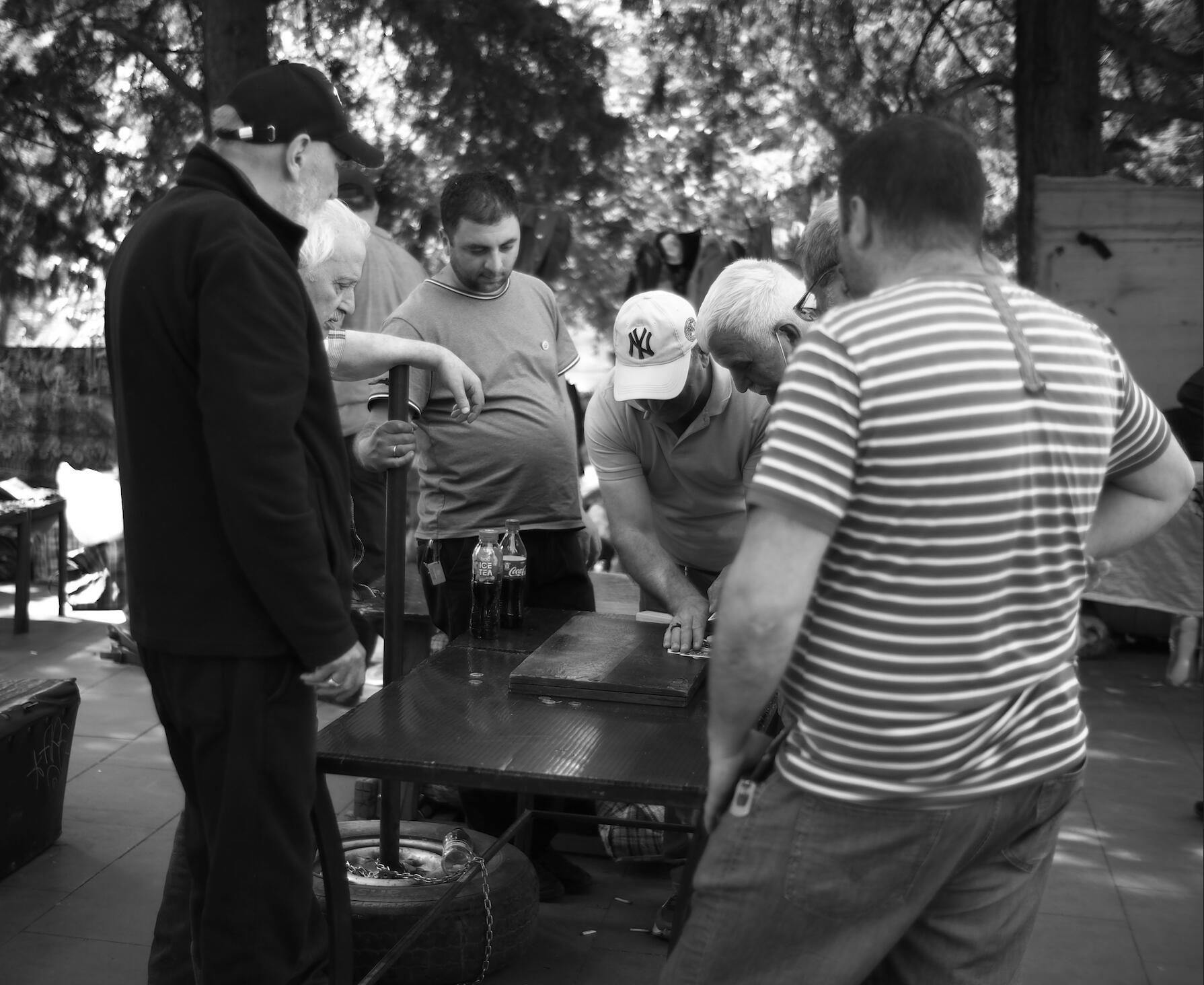
TL;DR: Seven or eight men lean over one low table under trees, and every head points at one hand pressing a few cards. The file reads as a digital capture turned black and white, likely a normal lens near f/2.8 to f/4 and around 1/500 s, all estimates from what the frame shows. The one mistake is a tree trunk growing out of a black cap, and half a step to the side would have fixed it.
The title is a Chinese proverb, 當局者迷,旁觀者清 / 当局者迷,旁观者清.
Every head points one way
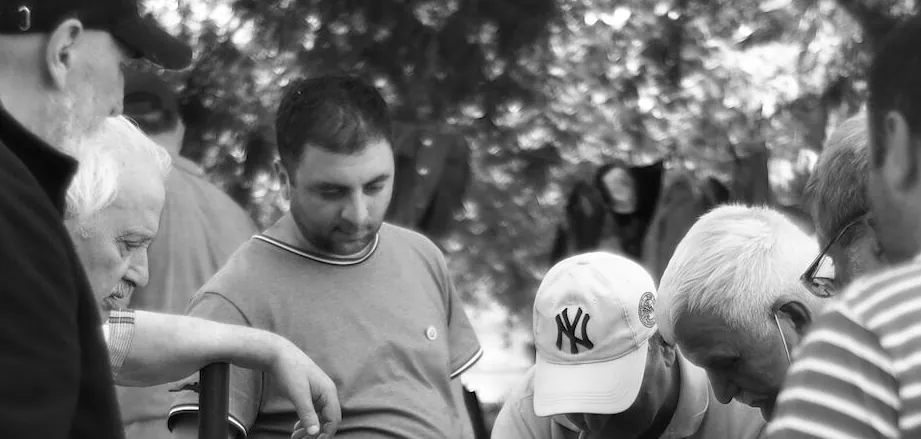
Before you see faces you see a direction. A black cap tips down, a young man's eyes go down, a white cap bows, a white head bends low, and a pair of glasses peers over a striped shoulder. Draw a line out of each head along its look and the lines all land in the same small spot, a hand pressing a few cards at the edge of a closed wooden board.
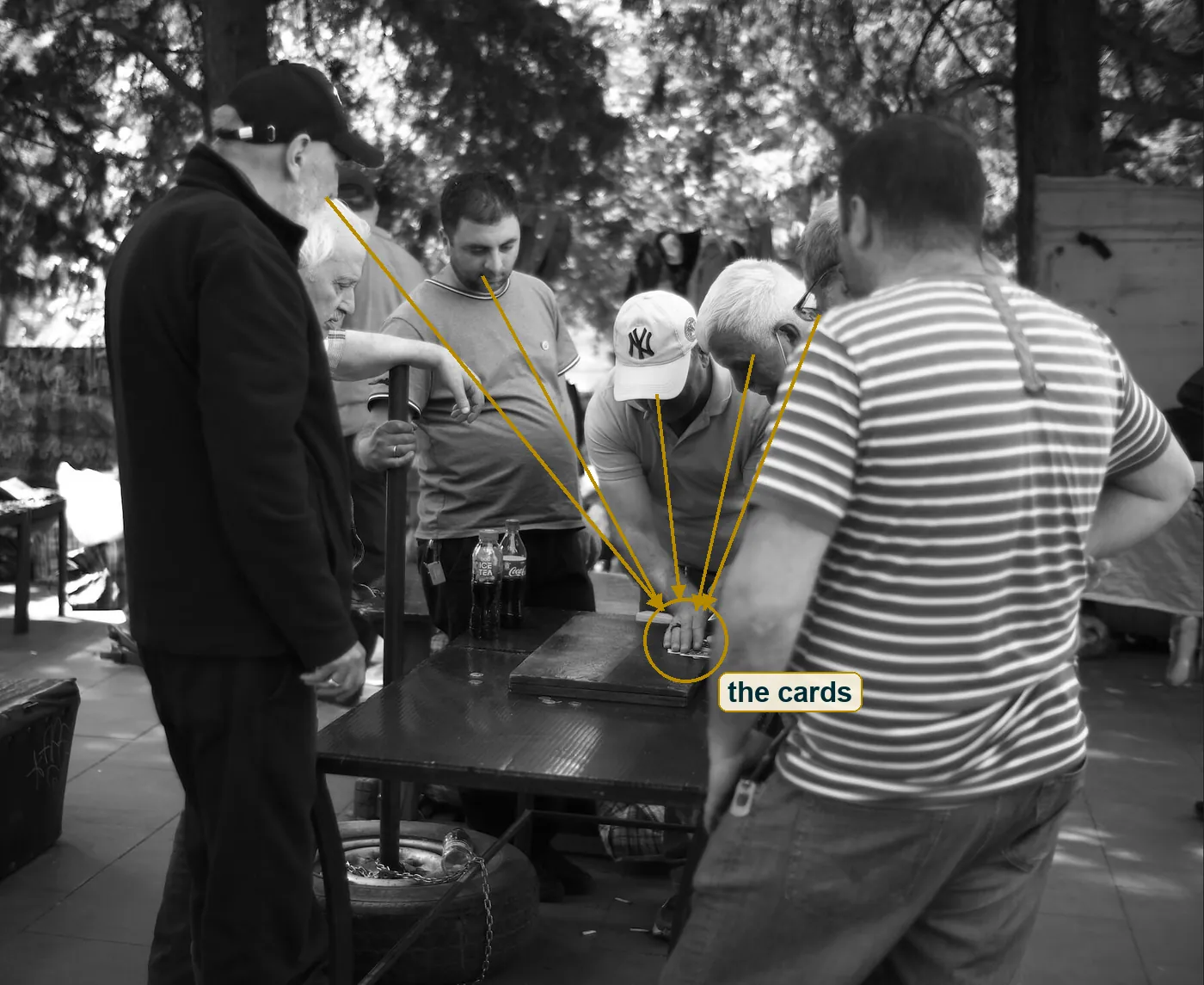
"See what a man does," says Confucius in James Legge's translation. Here five looks make the action legible before any face does. That is the whole subject of the picture. It's not the game, which you never fully understand, and it's not any one face. It's attention, made into lines you can follow with a finger. Seven or eight men stand here, depending on how you count the ones hidden behind other men, and nobody looks at the camera. The photo comes from Emin's old picture site, filed under "taking pictures". Date and place are not recorded, so this reading stays with what the frame shows and doesn't guess the rest.
What is on the table
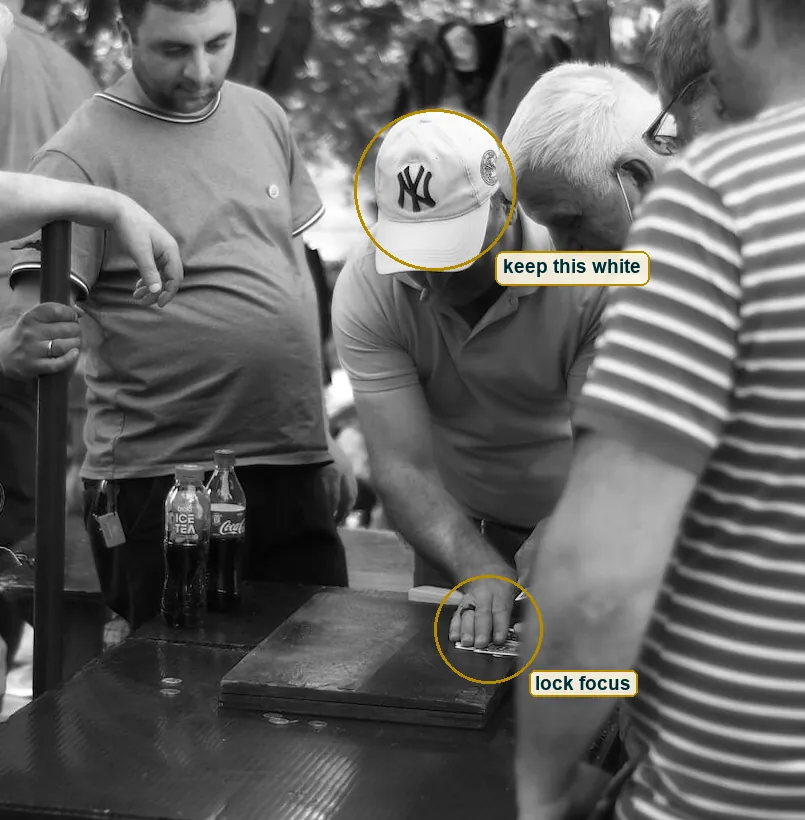
Look past the people for a moment and read the props. A low dark table with a ribbed top. A closed wooden board on it, maybe a backgammon case used as a flat surface for cards. A bottle of iced tea and a bottle of cola at the back edge. A few coins on the dark top. And under all of it an old car tyre on its rim, with a metal pole stuck in the hub and a chain wrapped round.
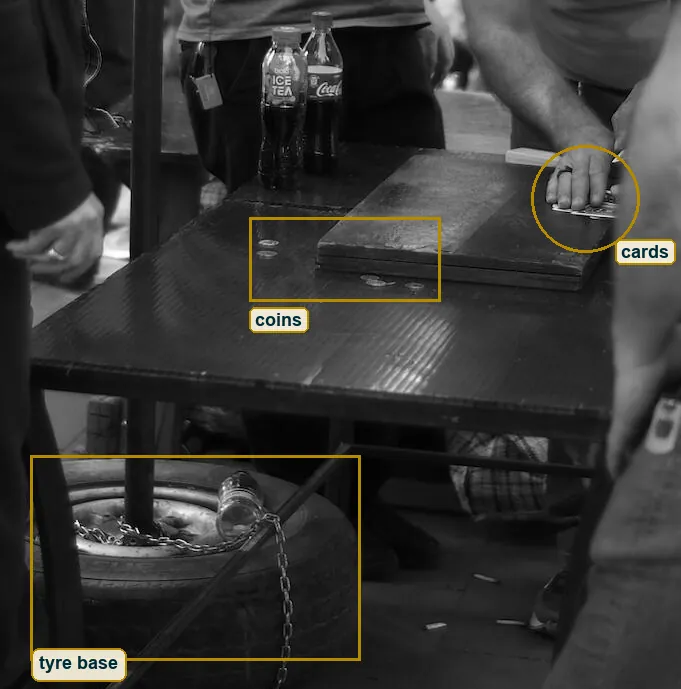
These things tell you more than a caption could. The tyre base and the chain say this corner is set up and used again and again, not put together for one afternoon. The coins say there is something at stake, but not much. The drinks say people stay a while. It's a place built out of leftovers, and it works. You don't need to know the rules of the game to know that this table matters to the men around it.
A ring of bodies
Now trace the heads in order. Black cap, young man, white cap, white hair, glasses, then the back of the striped man's head, down his back to the near edge of the table and up the black fleece again. You get a closed loop, and the table sits inside it.
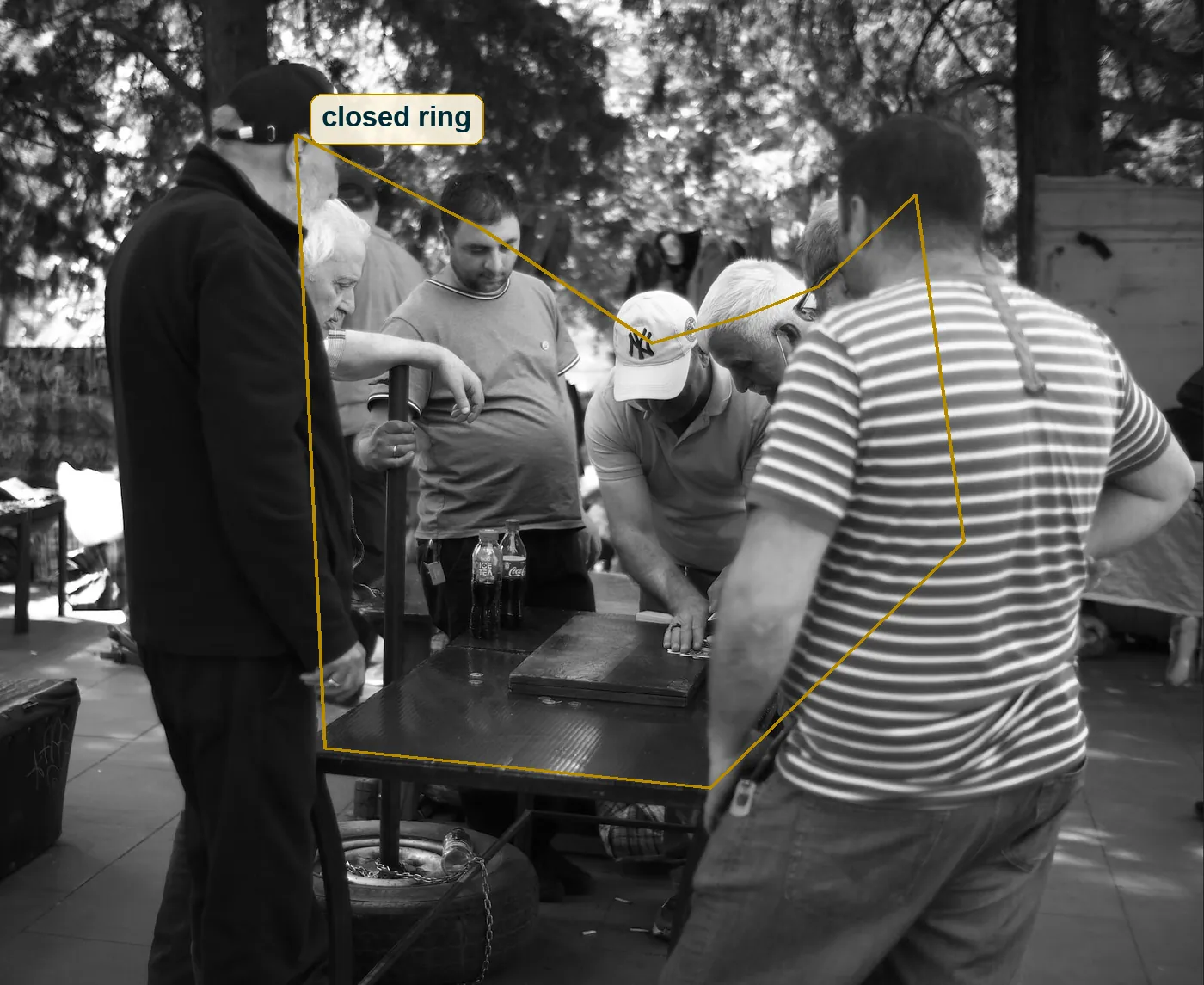
The Dutch historian Johan Huizinga wrote in Homo Ludens, in 1938, that the card-table belongs with the arena, the temple and the stage. All of them are playgrounds for him, spots hedged round, where special rules hold for as long as the game runs. That is exactly the shape you see here. The men don't need a fence or a sign. Their bodies are the wall. Outside the ring there are trees, a tarp, a bag, other tables, the ordinary world. Inside it there are a few cards and a rule everyone already knows. The photographer is not outside looking in. The camera stands in the gap of the ring, one more body in the wall.
Two backs and a gap
The two biggest shapes in the frame are not the subject. On the left a man in a black cap and black fleece stands in profile, nearly a silhouette. On the right a heavy man in a horizontally striped T-shirt turns his back to you with a hand on his hip. Both are cut by the frame edge and both are nearer than the table.
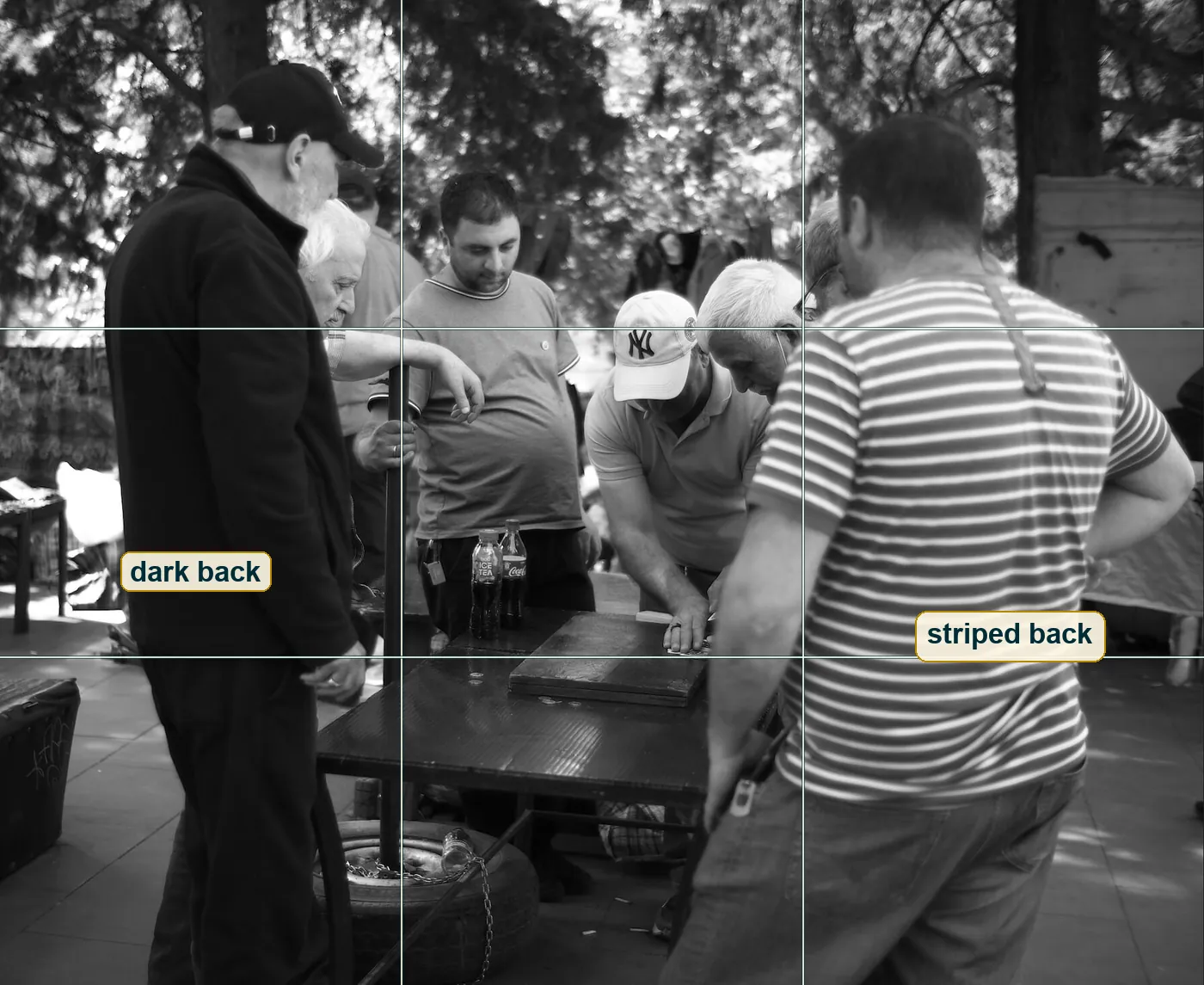
Put a thirds grid on it and the plan gets clear. The dark back fills the left column from cap to shoes. The striped back fills the right one. The table, the bottles and the bowed heads sit in the middle column, with the cards close to the lower third line. The metal pole runs just left of the left third line, almost parallel to it. Painters call a near dark figure like this a repoussoir, French for something that pushes back, because it pushes your eye into the space behind it. Here there are two of them, like curtains, and you look through the gap. The edge of the frame cuts both men, and that cut is the decision. Move it out and you see a crowd from outside. Move it in and you lose the feeling of standing in the second row.
Light through leaves
This is dappled light, and it's the hardest daylight to shoot well. The canopy turns the sky into one big soft source, so the faces sit in gentle even shade. Then holes in the leaves let through hard spots of direct sun, and those land on the white cap, on white hair, on the striped man's shoulders and on the paving.
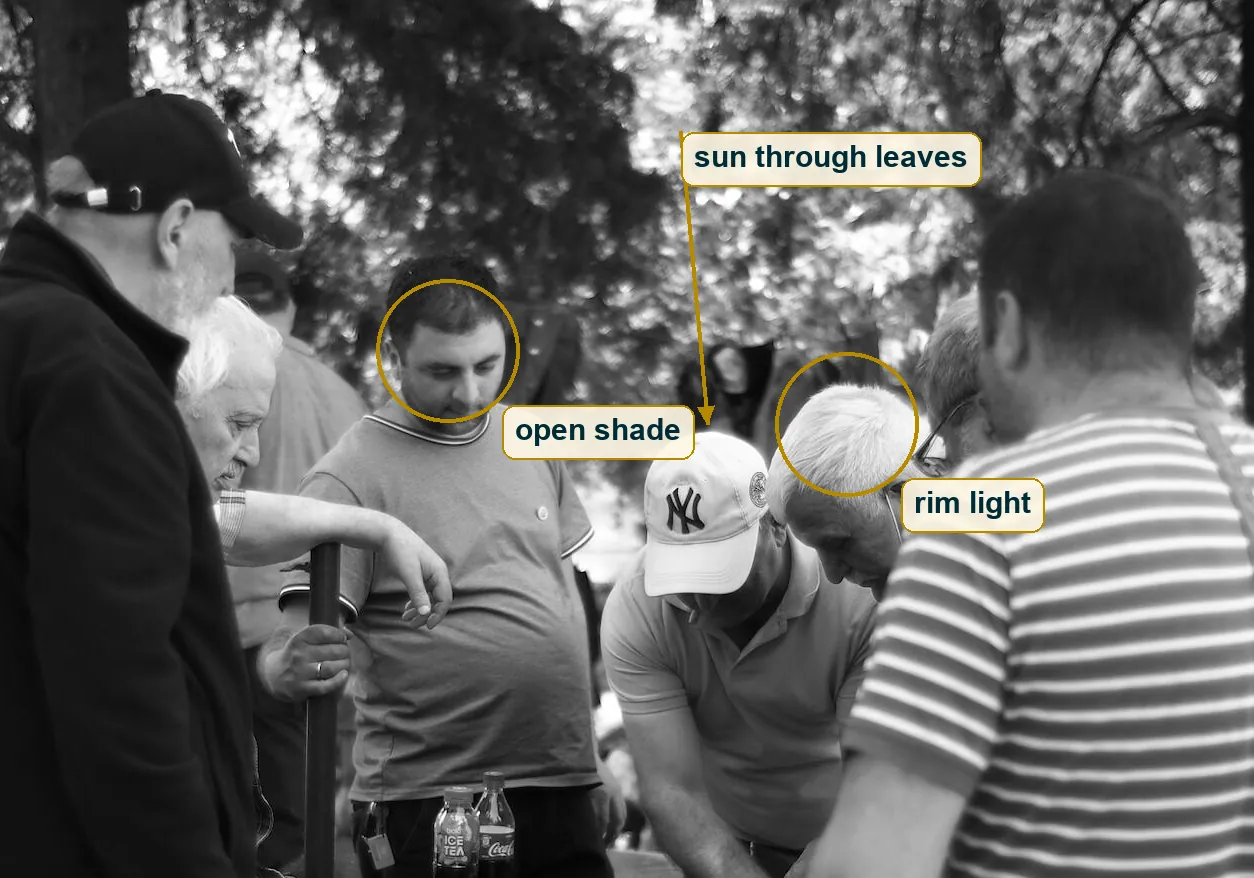
The direction reads as high and a bit behind the group. The tops of heads are lit and the faces under brims and brows are not, and the white hair of the man next to the white cap glows at its edge, which is what backlight does. Shadows are short, so it's probably the middle of a bright day, not early or late light. The short sleeves and full leaves point to warm weather, but one man wears a fleece, so the picture won't settle the season. The light helps where it puts a thin bright line round heads against the dark leaves. It hurts where it scatters bright spots that pull at your eye. The trick in this light is to expose for the shaded faces and simply give up the small sun spots.
Three greys that hold it
Black and white turns a scene into a map of brightness, and you can read this one with three samples. Measured in the file, a patch of the black fleece sits around 17 on a scale of 0 to 255, near black with almost no detail left. The young man's grey T-shirt sits around 120, a clean middle grey. The white bag at the left edge is 99 percent pure white, no texture at all.
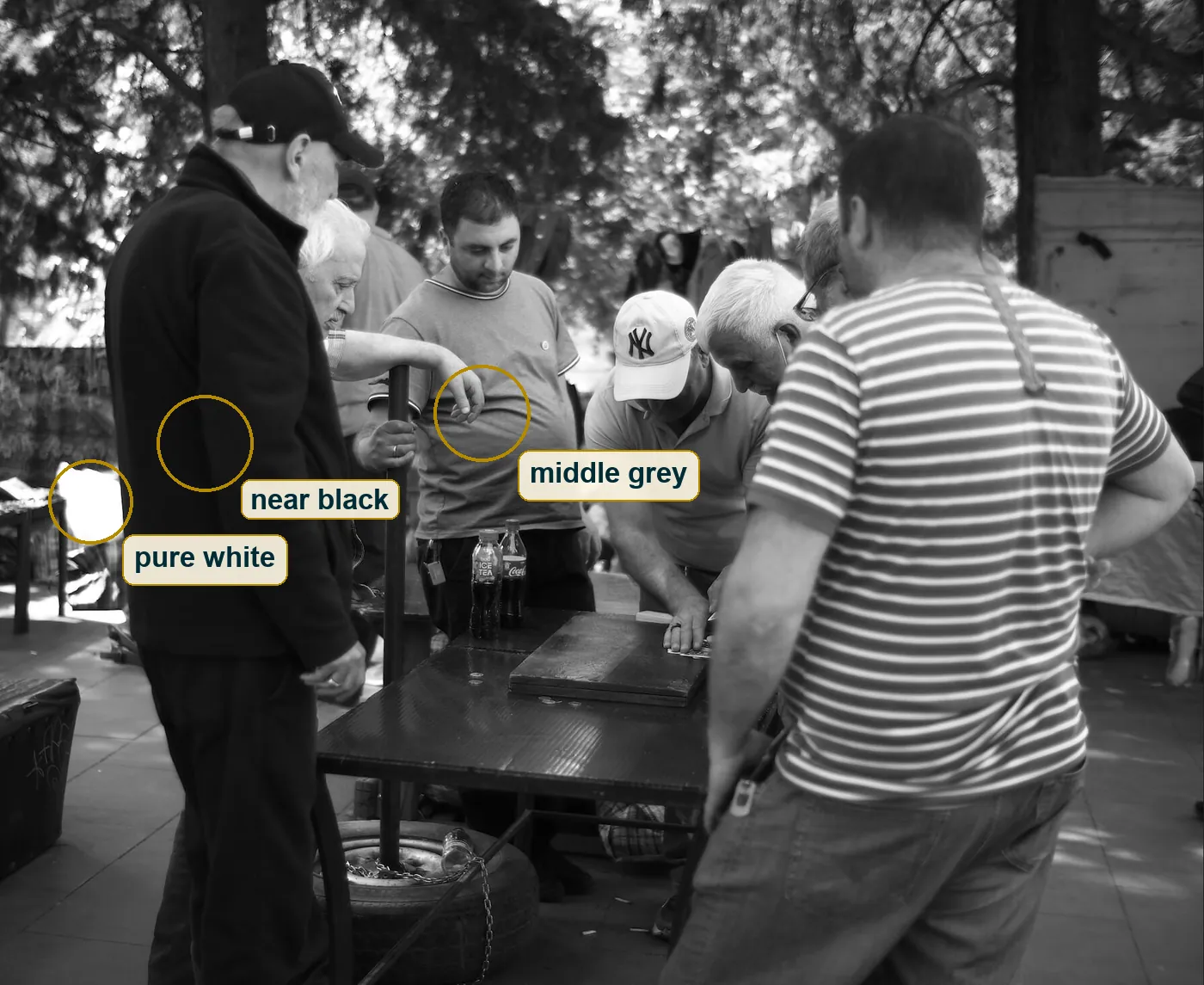
The white cap is the interesting one. A sample of its crown averages about 243 and only around 9 percent of it touches pure white, so the logo, the seams and the shade under the brim survive. Across the whole frame less than 1 percent is pure white. That means whoever exposed it protected the bright cap and gave up only small things, the bag and a few sky holes. Three tones do the work that a streetful of colours might undo. Fleece at 17, shirt at 120, cap at 243. Fewer choices make the attention harder to escape. Without colour the striped shirt and the leaves can't fight with skin tones, and the picture rests on three firm greys. The corners are darker than the centre, even enough that it looks like a vignette added in editing, not only lens fall-off.
The arm on the pole
The most human gesture in the picture is not at the table. An older man with white hair lays his forearm over the top of the metal pole, and his hand hangs loose in front of the young man's chest. A second hand with a ring grips the pole lower down.
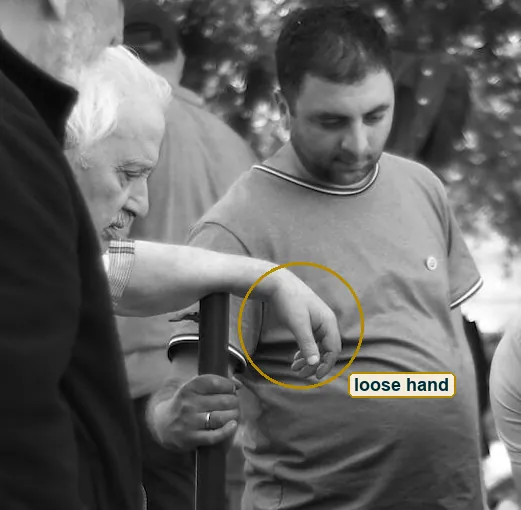
Bodies overlap so much that you can't be fully sure who owns which hand, and it doesn't matter. What matters is how easy it is. Nobody leans on a pole like that, with a hand hanging that close to a stranger's shirt. It's the contact of people who know each other and have stood like this many times. Everyone else in the frame is busy looking. This hand is the only part of the picture that is simply resting, and that rest tells you more about the place than the cards do.
The hand that waits
Now go to the target of all those looks. The dealer's ringed hand presses flat on a small stack of cards, and there is a pale card or box just behind it. The face above it is lost under a white brim. Nothing has been turned over yet.
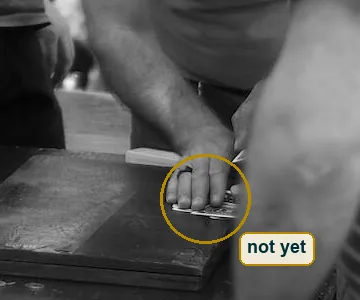
Huizinga has a sentence for this too, "Tension means uncertainty, chanciness". The picture is made of that. Henri Cartier-Bresson made the decisive moment famous, and people often read it as the peak of action. This frame shows another kind of decision, the second of most suspense, when every body is still because everyone is waiting. A frame one second later might show a winner and a loser, faces opening, a hand slapping the table. It would be louder, not better. The cards stay hidden, and that is what keeps you looking.
Reading the lens
No EXIF data exists for this file, so every technical point here is a reading with its reason. The pole and the table edges look straight, with no barrel bend. Perspective looks natural. The near figures are not stretched the way a wide lens stretches them, and the far ones are not stacked the way a long lens stacks them.
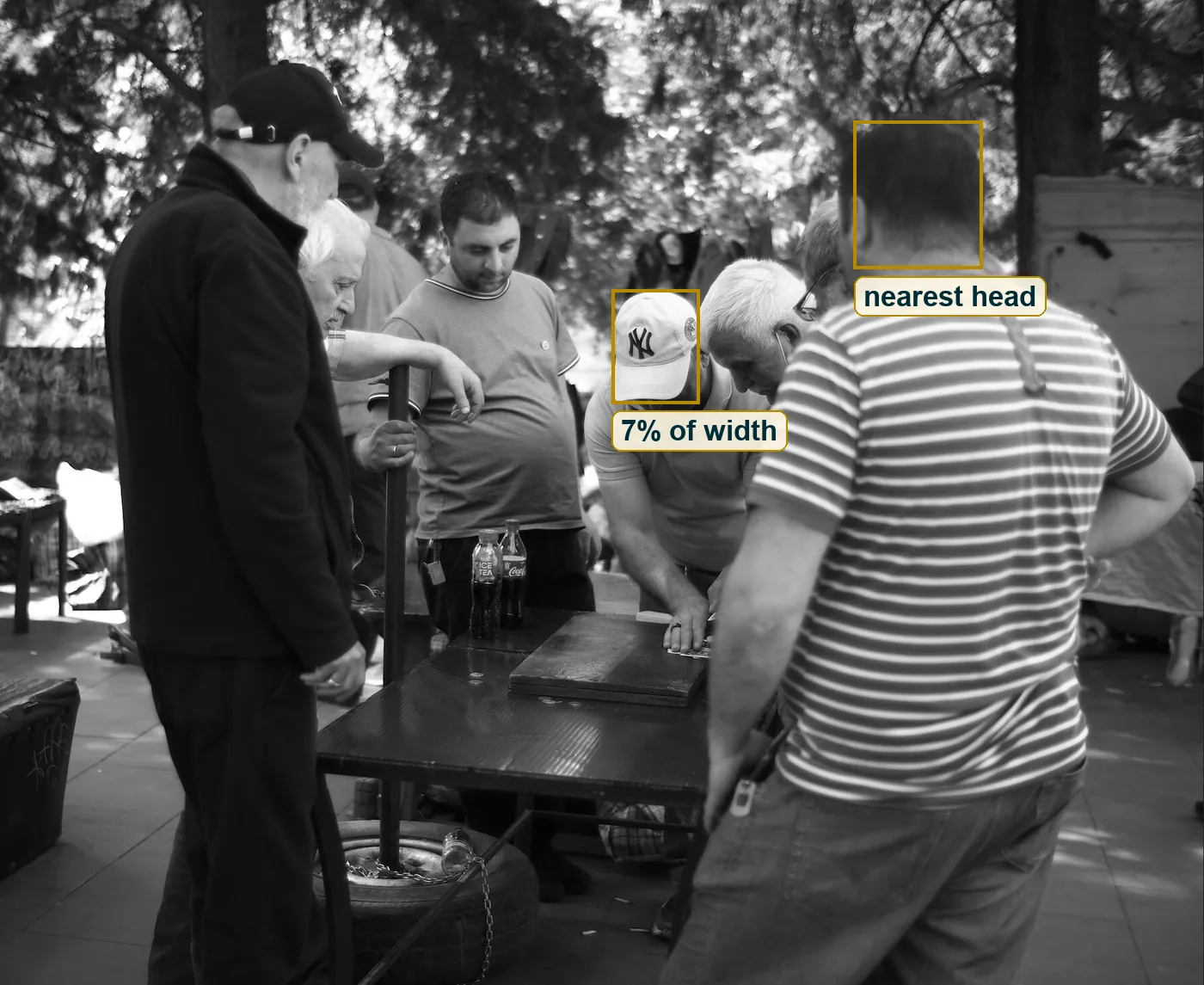
Size gives you the distance. The white cap spans about 130 of 1790 pixels, about 7 percent of the width. A cap is around 20 centimetres wide, so the frame is about 2.7 metres wide at the dealer. With a 35mm lens on full frame that puts him around 3 metres away, and with a 50mm around 4 or a bit more. The striped man is much nearer, maybe a metre and a bit. So the photographer stood inside the ring, close enough to be bumped, with something in the normal range, about 35 to 50mm. The file is 1790 by 1464 pixels, a ratio of about 1.22 to 1. That's close to 5:4 and few cameras make it natively, so the frame was likely cropped from 3:2 or 4:3, which also means the lens was a little wider than the crop suggests.
Shutter, aperture and the soft arm
Start with aperture. The dealer's hand, the young man and the hanging arm all sit in one plane of focus. The striped man's forearm, much nearer, is soft with smooth gradients and no skin detail. The trees behind are a busy soft blur.
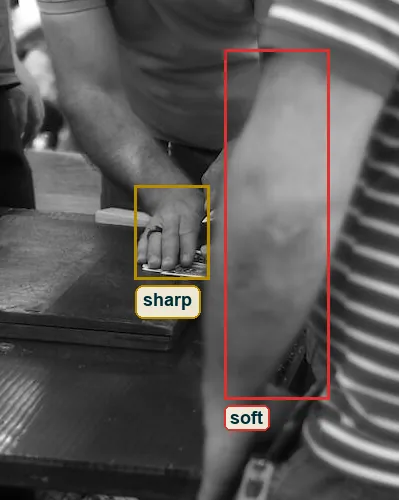
Run the numbers for a 35mm lens focused at 3 metres. At f/2.8 the sharp zone runs from about 2.5 to 3.8 metres, so a forearm at 1.5 metres goes soft and the trees go soft. At f/8 the zone runs from about 1.9 to 7 metres, the trees would firm up and the stripes would get close to sharp, loud enough to fight the cards. The background here is too soft for f/8, so f/2.8 to f/4 fits best. Then shutter. Hands at a card table move, and this hand shows knuckles and a ring with no smear, so at least 1/250 s, more likely faster. Open shade on a bright day is about exposure value 12 at ISO 100, which gives f/2.8 at 1/500 s or f/4 at 1/250 s. At 1/30 s the dealer's hand would be a grey smudge and the photo would be about motion, not waiting. So a fair reading is f/2.8 to f/4, around 1/500 s, ISO 100 to 400. Treat that as an estimate with reasons, not a record.
Film or digital
Look at the young man's face and grey shirt at full size. The texture is fine and even, partly smoothed, with some blocky compression in the darker tones. There is none of the clumped, irregular grain that silver film leaves in smooth middle greys.
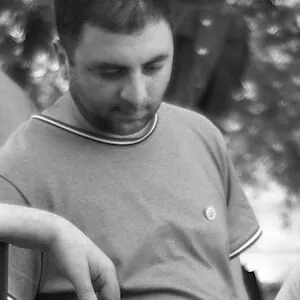
Clean shadows, a clarity-heavy look and a vignette that seems added in editing all lean toward a digital capture turned black and white. But a fine scan of slow film can look this clean too, and a 1790-pixel file has lost a lot of the evidence. So the honest answer is that it leans digital, and the file can't prove it. If you want the film look on purpose, it's grain in the middle greys you'd add, not in the blacks.
The lookers-on
This picture has old relatives. Paul Cézanne painted a series called The Card Players in the early 1890s, men bent over a table, eyes down, the game itself almost invisible. Earlier painters showed card games as loud tavern scenes with drink and money. Cézanne took the noise out and kept the concentration. This photo does the same, even with the coins and the cola in it.
In photography the home is humanist street work, the line that runs through Cartier-Bresson, unposed people in public space shot from close by someone who stands among them. And there is a writer who saw this scene four hundred years ago. Francis Bacon, in his essay Of Followers and Friends, gave advice on friends and noted that the people watching a game often see more of it than the players. Most of these men are not playing. They are lookers-on, and their faces carry the game better than the player's hidden face does. The photographer is one more looker-on, and so is everyone who looks at this picture now.
The one mistake
The best part is the convergence of looks. The one real mistake sits at the top left. A dark tree trunk comes straight down out of the frame and meets the black cap with no gap. Both are near black, so in grey they read as one shape, and the man seems to grow a tree out of his head.
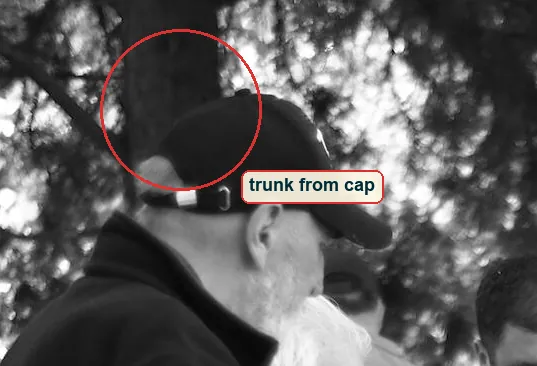
In colour the bark and the fabric might have separated. In black and white they can't, and that is the rule to learn. Mergers get worse when you drop colour. The fix is cheap. Half a step to the right, or the camera a hand lower, and the trunk slides off the cap into the leaves. Confucius, in James Legge's translation of the Analects, says "When you have faults, do not fear to abandon them." Here the fault is a position, and abandoning it costs half a step. You can't move the tree or ask the man to step aside without breaking the moment. You can move yourself. The other things that pull at the eye, the loud stripes and the blown white bag at the left edge, are smaller costs. The merger is the one a viewer feels without knowing why.
Try this
In the Analects, Youzi says "a natural ease is to be prized", in James Legge's translation. At a card table, ease is something to join, not to stage.
Find any group round a table, a chess board in a park or a backgammon game outside a café, and stand in the second row. Lock focus and exposure on the hands, then pull the exposure down until the brightest shirt or cap keeps its texture. Before you press, look at the top of every head for a pole or trunk, and take half a step until each one is gone. Make ten frames in twenty minutes and keep the one where every look lands in the same place.
Then go back to the first frame of this essay and count the heads again. You'll find you are doing what the men do, leaning in toward one hand, waiting for a card that never turns.