Mountains never meet, but people do
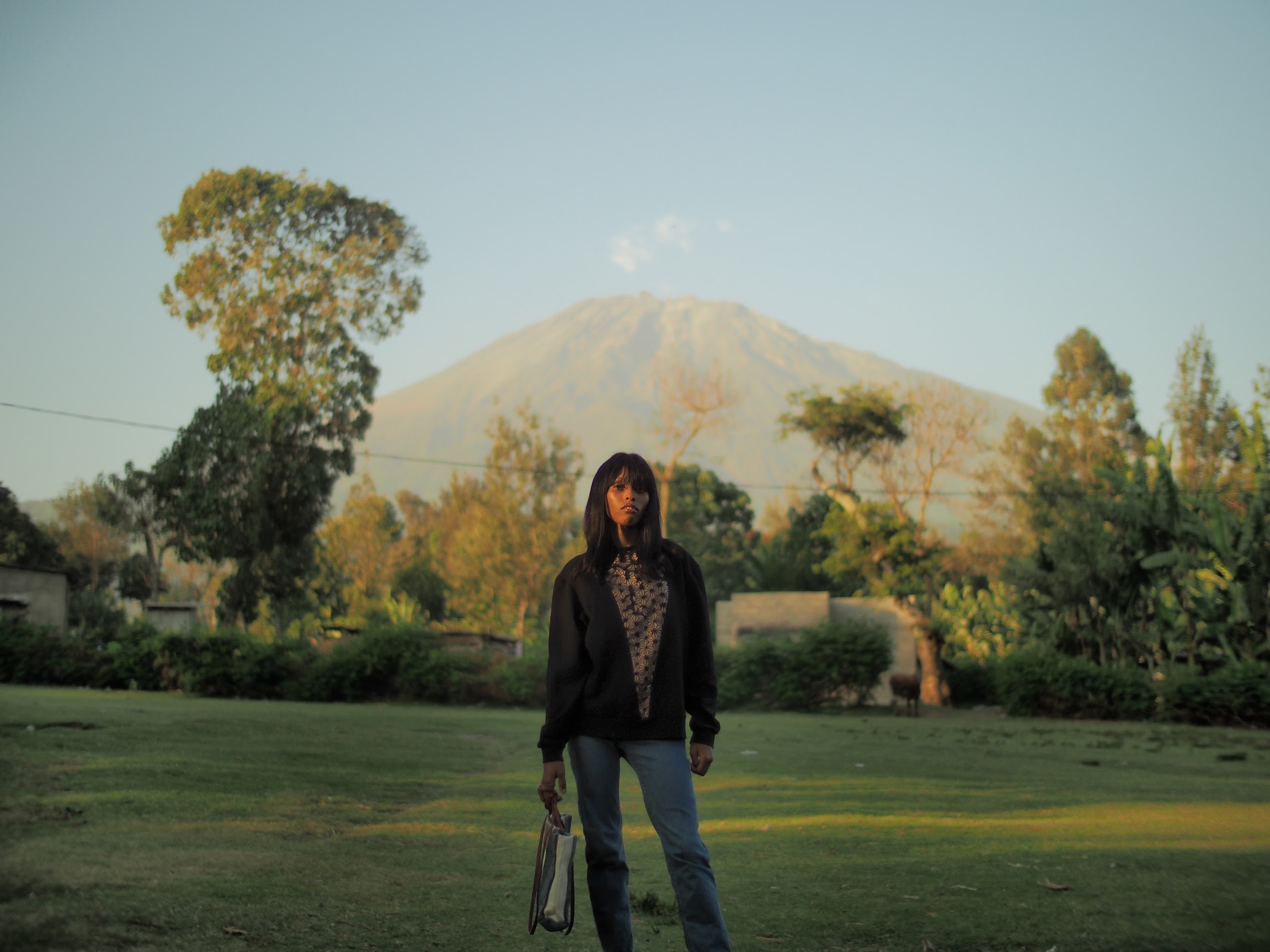
TL;DR: A woman stands dead centre on a lawn and the summit of a huge hazy mountain sits straight above her head, lined up by the photographer's feet. Low sun lights the treetops and a strip of grass while she stands in open shade, 2.3 stops darker than the sky behind her. The original file says Olympus OM-D E-M5 Mark II, manual mode, 1/8000 s at ISO 200, 17:56. The lens left no data, and the one fix is the wire at her brow.
The title is a Swahili proverb, Milima haikutani lakini binadamu hukutana.
A mountain wearing a person
You see the mountain first, and only then you see that it is standing on a person. A young woman stands on a mown lawn, square to the lens, arms down. Straight above her head a huge pale cone climbs into a clear sky, and its summit sits on the same vertical line as her face.
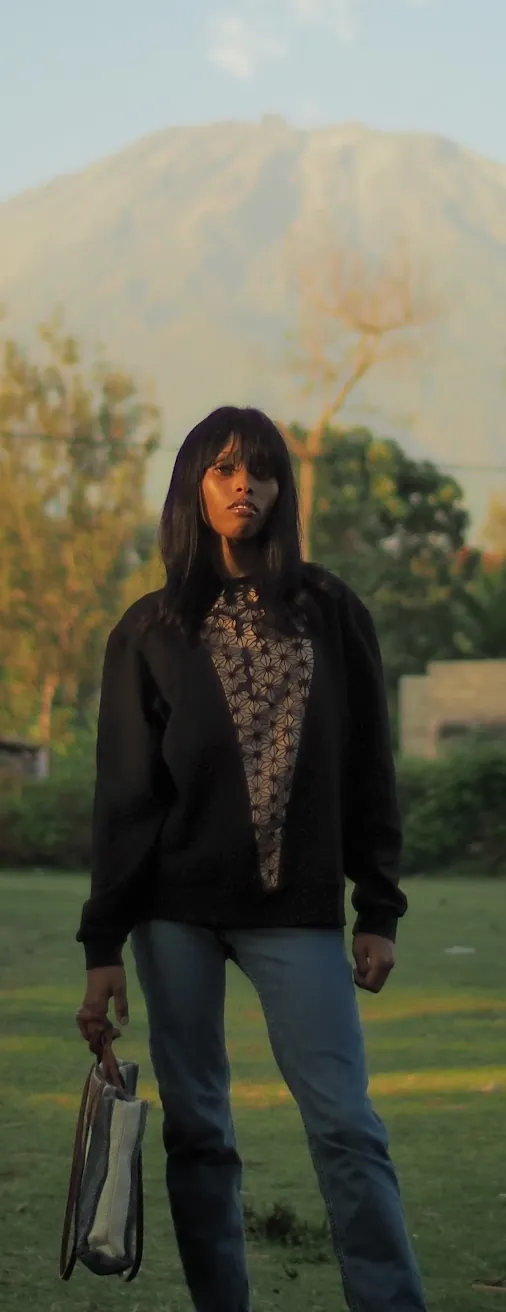
Most portraits hand you the face first. Here your eye lands on the bright slope, goes up to the peak and slides down the centre line, and only at the end it reaches her face, darker than almost anything around it. The mountain gets the light and she gets the centre.
There is an old Swahili saying that fits the mood, Milima haikutani lakini binadamu hukutana. Mountains never meet but people do. A mountain stays where it is, and a portrait is the moment a person walks in front of it and stays for a second. The original file gives a date, 27 August 2025 at 17:56 by the camera clock, and no place, so everything below stays with what you can see and what the camera wrote down.
One hand full and one hand empty
Look at her before you look at the mountain. A black top with long sleeves, dark straight hair with a heavy fringe, light jeans. Down the front of the top runs a V-shaped panel with a star-like lattice in brown and cream. In her right hand, on your left, a striped tote hangs by brown handles near her knee. Her other hand hangs loose and empty.
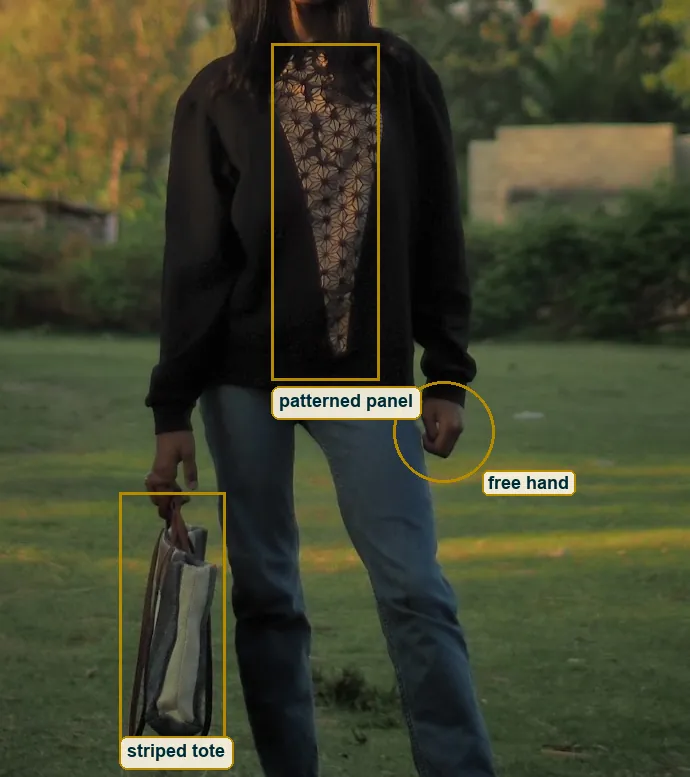
A frontal standing pose is symmetric, and perfect symmetry reads stiff, like a passport photo. Here a few small things break it. The bag pulls weight to one side and the free hand curls a little. The panel draws a V that points from her face down to her waist, the shape of the mountain turned upside down.
None of it is loud, and all of it keeps her from looking like a cut-out pasted on a view. No smile, no wave, no hand pointing at the peak. Her mouth is closed and her eyes go straight into the lens. She is not showing you the mountain. She is standing in front of it, and that is a different picture.
The summit sits on her head
The highest point of the mountain sits about 31 percent down from the top of the frame and 50.5 percent across. The crown of her head is at about 49 percent across. That is a gap of roughly 35 pixels in a frame 2302 pixels wide.
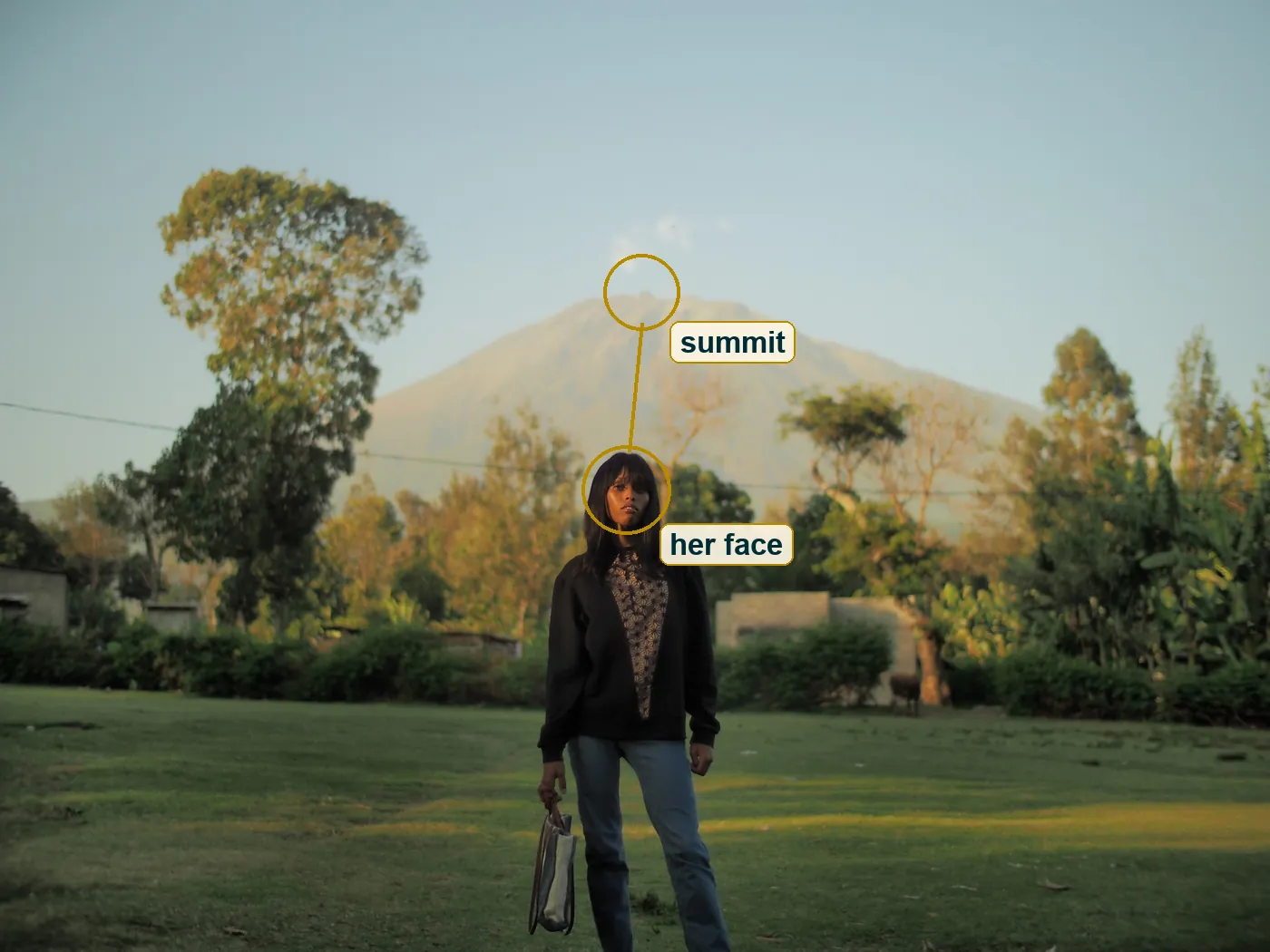
This does not happen by luck. The rule behind it is parallax. The nearer a thing is, the more it slides in the frame when you move. The mountain is far away, so it barely moves when the photographer moves. She is a few metres away, so she moves a lot. Half a metre to the left and the summit hangs over her shoulder like a balloon.
So someone walked until the two shapes stacked. Those 35 pixels are a few centimetres of camera position. It is the old tourist trick, the person holding up a leaning tower, done quietly and without the joke. When you want something far away to sit on something near, your feet do the work, not the zoom ring. Zooming changes how big things are. Only walking changes where they sit against each other.
One tall triangle
The frame is 4:3. The camera made it 4608 by 3456 pixels, the published file is half that, 2302 by 1726, and all pixel numbers here are from the published file. She stands almost exactly on the vertical centre line. The two flanks of the mountain run down and out from the summit on both sides of her, so her body is the axis and the slopes are the sides of one tall triangle with the peak on top.
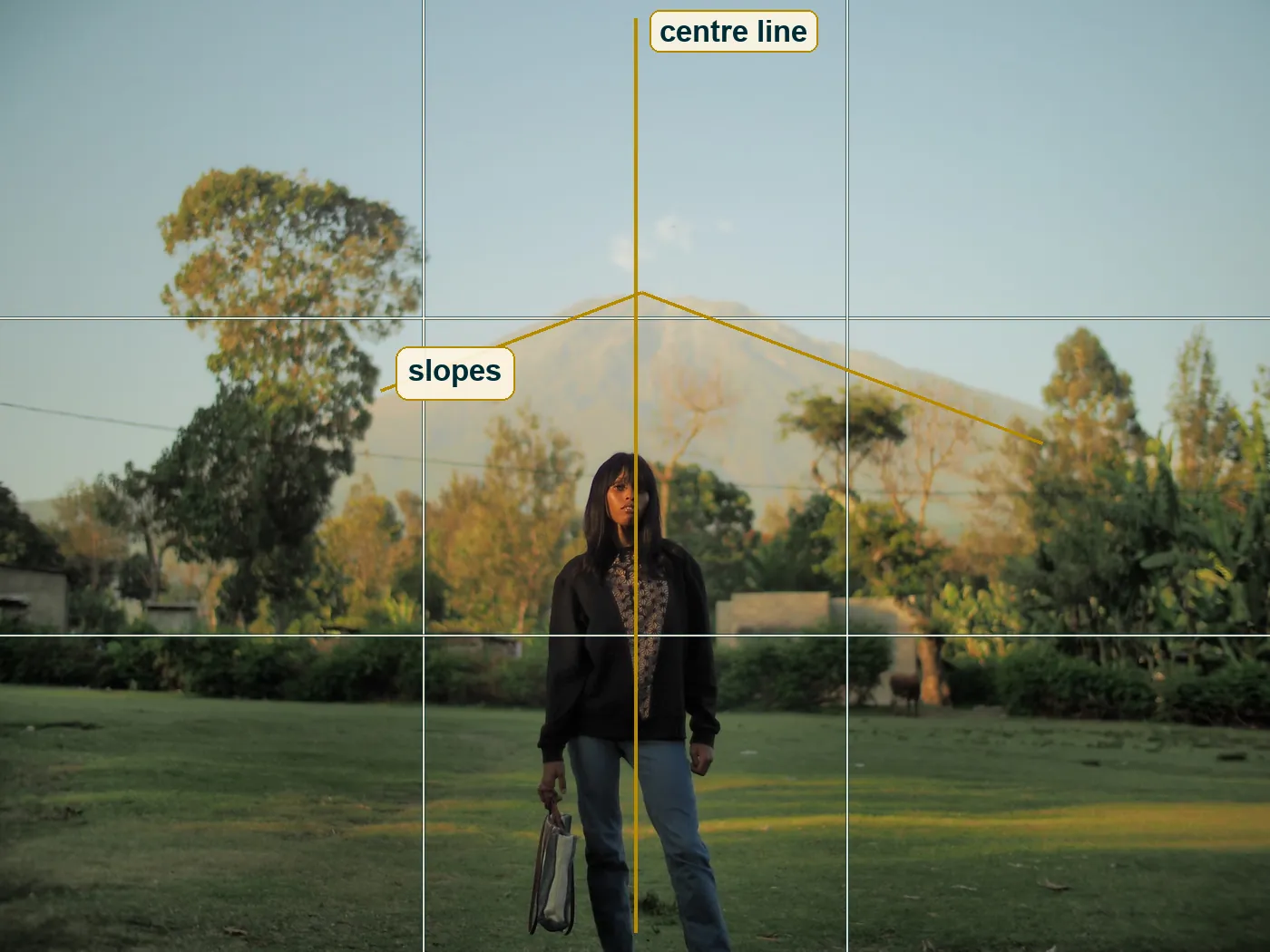
Now look at the thirds. The upper line runs just under the summit and the lower line runs along the hedge and her waist. So the picture does not ignore the rule of thirds. It uses the two horizontal lines and refuses the two vertical ones, and that is a good way to break a rule, half of it on purpose.
The weak edge is the bottom one. The frame cuts her at the shins, so her feet are gone. In a full-length portrait a cut that close to the ankles reads like an accident. Show the feet and give the lawn a job, or cut higher at the thigh and give the space to the sky.
Where the sun is
The light comes low from behind the camera and a little to one side. The proof is in the trees, not in her face. The top of the big tree on the left glows amber and olive, and its lower half drops into dark green. Measured in the file, the lit crown is almost 2 stops brighter than the leaves under it, so more than three times the light.
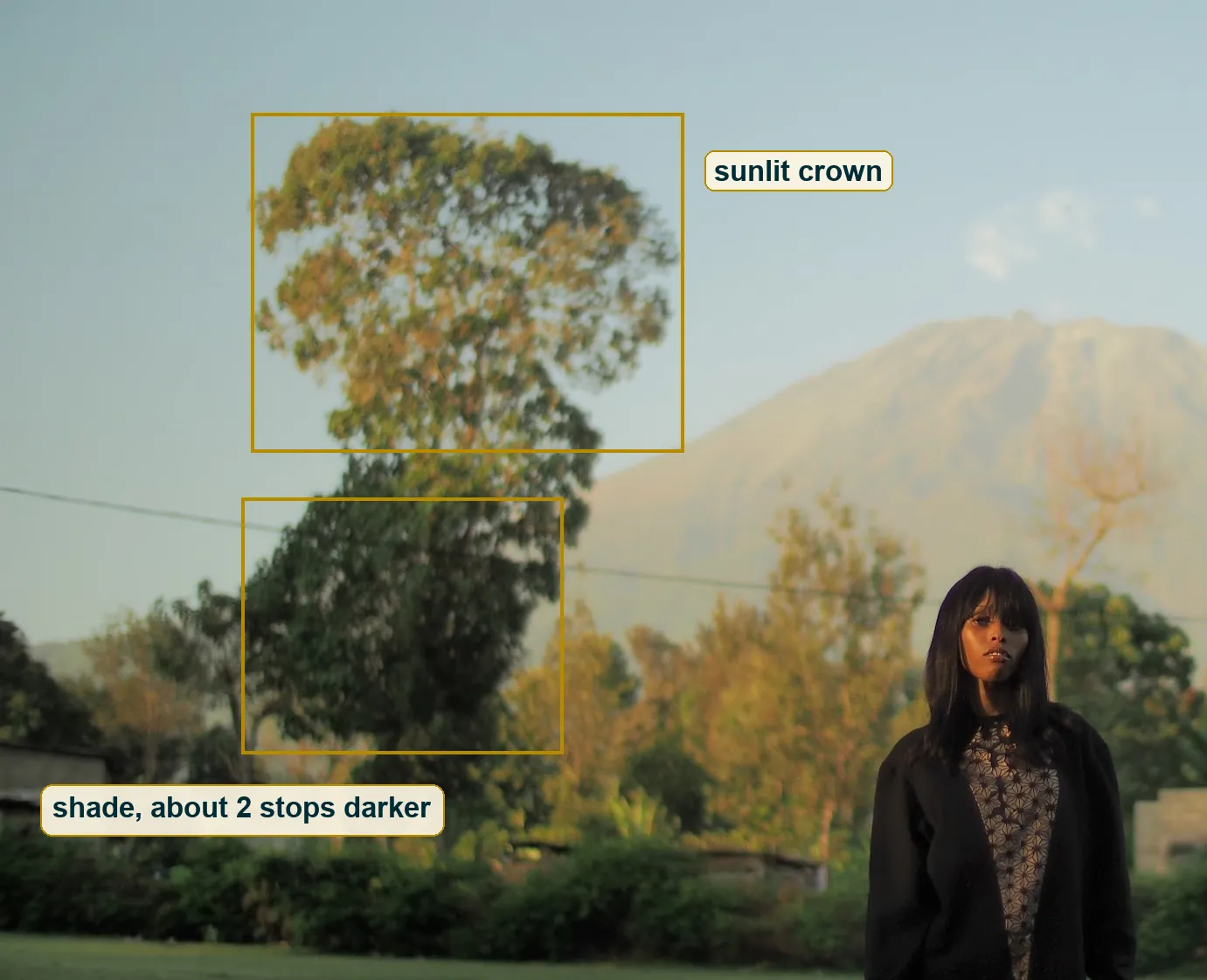
Low sun lights the top of everything first and the bottom of everything last. When it sits a few degrees over the horizon, hedges, walls and houses throw long shadows over the ground, and only the tall things reach up into the light. That is why the treetops on the right carry the same warm tone, and why the hedge and the lawn under them stay cool.
Golden hour is about angle first and colour second, because low light travels through much more air and loses blue on the way. From one frame you can't tell morning from evening, low sun looks the same both ways. The camera clock settles it, 17:56, so this is evening light. What you can also tell is that this light moves fast. On a flat lawn the line between sun and shade can travel a metre in a few minutes, so the photographer had a short window and used it.
She stands in the shade
In the middle of the lawn behind her lies a strip of sunlit grass. Where she stands, the grass is in shade and so is she. Something behind the photographer blocks the sun from that spot.
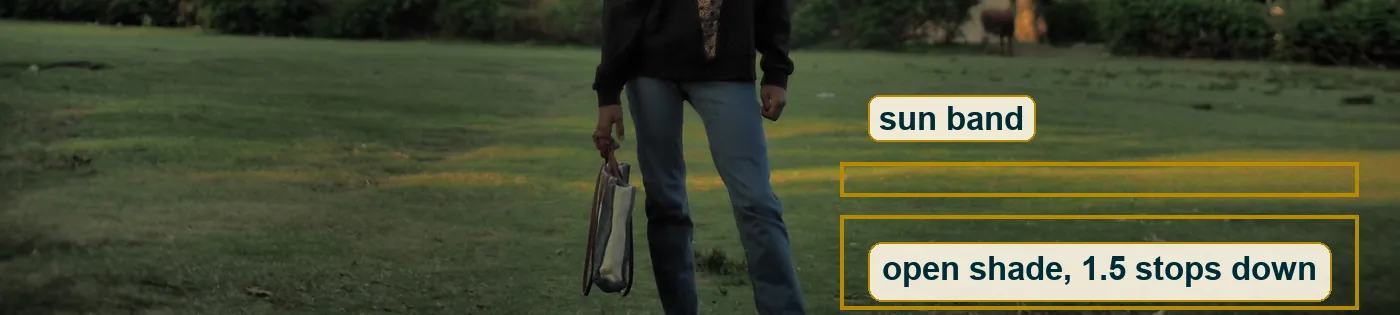
The numbers from the file are simple. The sunlit band is about 1.5 stops brighter than the shaded grass in front of it. The sky behind her head is about 2.3 stops brighter than her face. So the person, the reason for the picture, stands in the darker part of the scene, and the mountain and the treetops get the warm light.
Open shade is kind light. It comes from the whole sky and not from one point, so there is no hard shadow under her nose or her brows. Her face has a faint warm glow, likely light bouncing back from the bright grass and the lit trees. A few steps back, inside the band, the low sun would hit her face straight on. Warmer, more contrast, and probably squinting eyes. The photographer chose soft over bright. The cost is that she loses the fight for your attention to a mountain, and the picture needs her to win it a little more.
Air paints the mountain
The mountain is the palest and flattest thing in the picture, and that is not a focus problem. It is air.
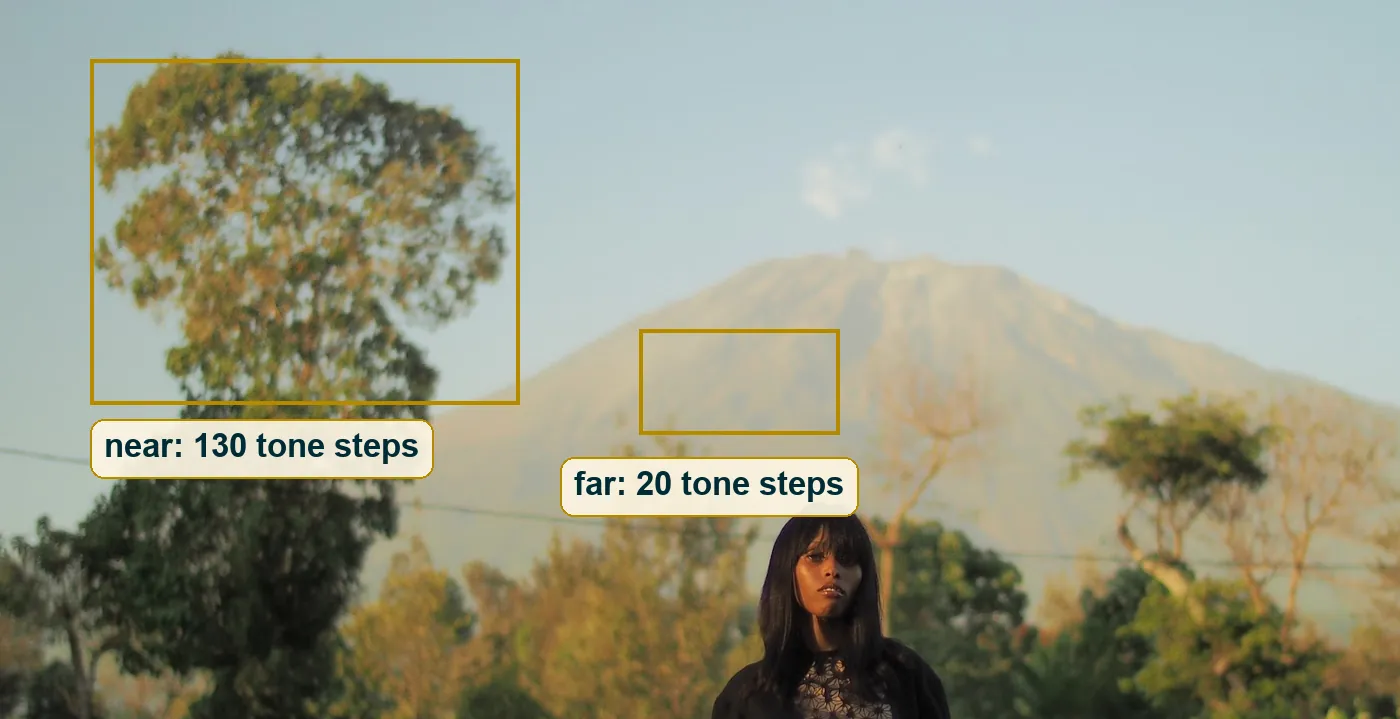
You can measure it. Inside the box on the near tree the brightness runs from about 72 to 201, a range of about 130 steps out of 255. Inside the box on the mountain it runs from about 173 to 192, about 20 steps. Many kilometres of air scatter light into the view, lift every dark and pull every colour toward the blue-grey of the sky. Painters call this aerial perspective. Leonardo da Vinci painted it on purpose, centuries before cameras.
This is why the mountain reads as far and huge even though the picture is flat. Your brain reads low contrast as distance. On a clear day after rain it would look closer and smaller. At this size no bright snowcap shows on the summit. The top is no brighter than the sky around it, so the picture gives you a shape, not a name.
Reading the lens
The original file names the camera, an Olympus OM-D E-M5 Mark II. Its Micro Four Thirds sensor is half the width of full frame, so every focal length works like double. The lens fields are empty, focal length 0 mm, aperture 0. That is what a manual lens without electronic contacts leaves behind, and the file also says manual focus. So the lens is still a reading from shapes.
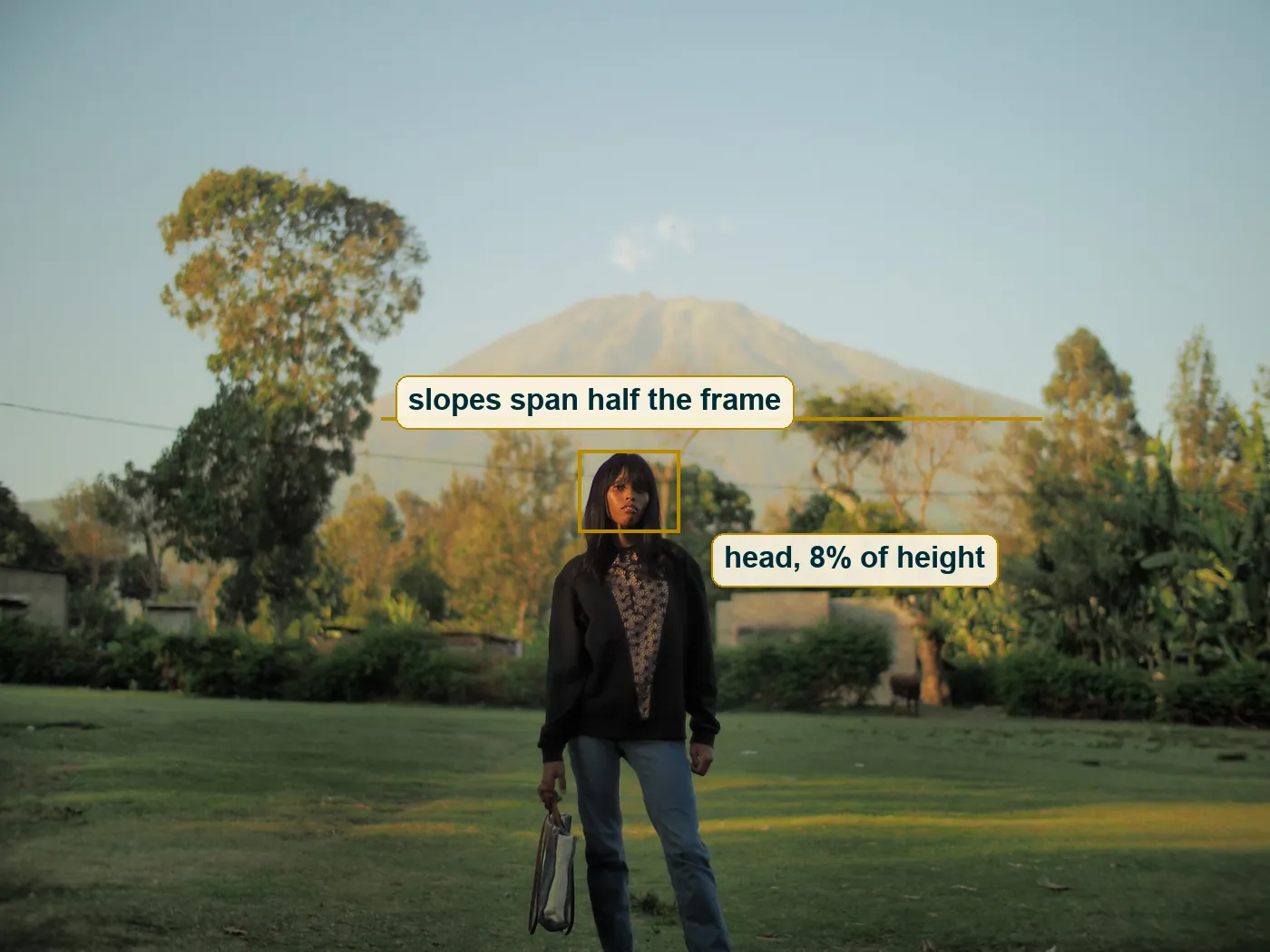
Start with what is missing. The block walls stand upright, the frame edges are not stretched and her head is not big against her legs. Those are the marks of a wide lens held close, and they are not here.
Then use her body as a ruler. From crown to shin she covers about 900 pixels of a 1726 pixel tall frame. A grown woman from crown to mid-shin is roughly 1.3 metres, so the frame is about 2.5 metres tall and 3.3 metres wide where she stands. A 50mm-equivalent lens covers that width from about 4.5 metres. A 35mm-equivalent from about 3.2 metres. A phone's main camera, around 26mm, from about 2.4 metres.
Now the background. Perspective comes from distance, not from focal length. From 2.4 metres with a wide lens she would grow and the mountain would shrink to a hill on the horizon. Here the slopes still span about half the frame width at mid-height, which points to a normal lens, about 40 to 60mm equivalent, from 4 to 5 metres. On this camera that is a 20 to 30mm lens, and 25mm is the classic manual normal lens for the system. Hold that loosely.
The 4:3 shape is simply the sensor, 4608 by 3456, so nothing was cropped. Because the verticals stand straight, the camera was held level. If the frame is not cropped, the level centre line marks the camera's height, and here it crosses her at the brow. So the lens was near her eye height, not low.
Shutter aperture and ISO
Two of these numbers are known now and one is not. The camera wrote 1/8000 s, ISO 200, manual exposure, mechanical shutter and image stabilisation on. It wrote no aperture.
Shutter first. 1/8000 s is the fastest the mechanical shutter of this camera can go. Nobody needs 1/8000 s for a person standing still. You end up there when you shoot a fast lens wide open in bright light, and the shutter is the only dial left to stop the light. ISO 200 is the base of this sensor, the cleanest it gets. So the photographer turned everything down and the aperture stayed open.
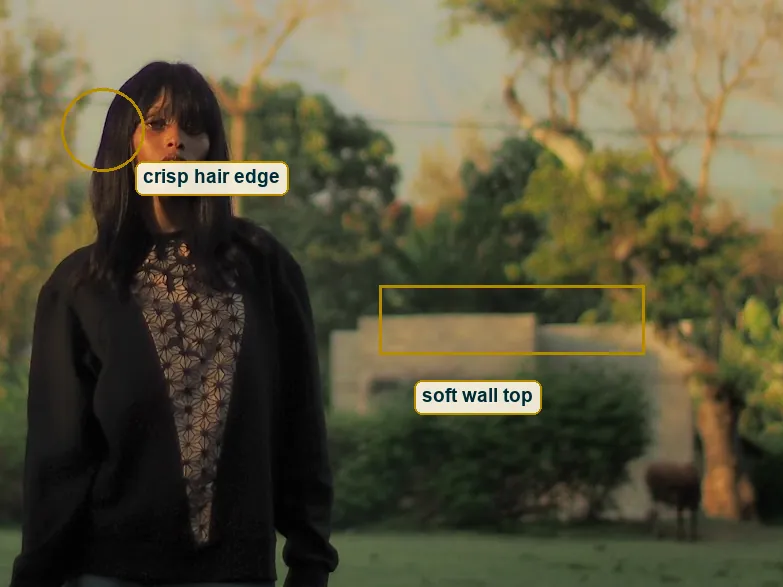
Aperture next, and this one is a reading again. The light math helps. In full sun at ISO 200 a normal exposure is about f/16 at 1/200 s. 1/8000 s is about 5.3 stops less light, which lands near f/2.5 for sunlit things. She stands in shade, so the lens was open at least that wide, around f/1.4 to f/2.8. The edge of her hair against the sky goes from dark to light in about 3 to 8 pixels. The top of the block wall behind her takes 6 to 12. So the background is soft but readable, not melted. On a full-frame camera at 50mm, focused at 4.5 metres, f/5.6 blurs a far background by about 6 pixels in this file, close to what you see. At f/1.8 that blur grows to about 20 pixels. The wall turns into a beige cloud and the place disappears. At f/11 the wall gets almost sharp, and so does the wire. Call it f/4 to f/5.6 in full-frame terms. On this 2x sensor that look is about f/2 to f/2.8 on the lens itself, and that fits the 1/8000 s.
The earlier guess for this post, 1/250 s and f/5.6 with no data, was wrong on the shutter by five stops. The look was right, the route was different. A wide aperture and a very short time give the same exposure as a small aperture and a longer time, but not the same picture. Open wide, the wall behind her goes soft and she separates from it.
Digital file film manners
The flat sky tells you most. In a patch of clear sky the brightness varies by about 1.5 levels out of 255.
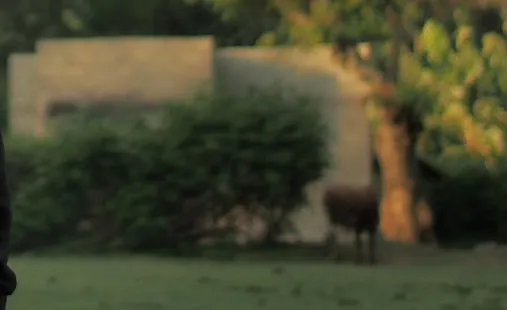
Film grain would show up exactly there, as an even, crunchy texture over the smooth blue. There is none. In the dark parts the texture is smeared and a little blotchy, the way noise reduction and JPEG compression leave it. No border, no dust. This reads as a digital file.
The grade borrows from film. The brightest point in the file sits at about 221 of 255, and not even one pixel in a thousand climbs past 215 in any channel. Nothing touches pure white, not even the sky at the horizon. The original JPEG came straight out of the camera, firmware 4.1, picture mode Natural, normal gradation, and its own brightest pixel is 236. So no edit pulled the highlights down. The manual exposure did. The deepest blacks still reach almost zero, so this is not the lifted, milky black of many film presets.
Phone processing usually lifts a dark face toward a bright sky. Here it stays 2.3 stops under, because a dedicated camera in manual mode does not lift anything. It writes what you set.
Where this picture comes from
Two lines meet in this frame, one from photography and one from poetry.
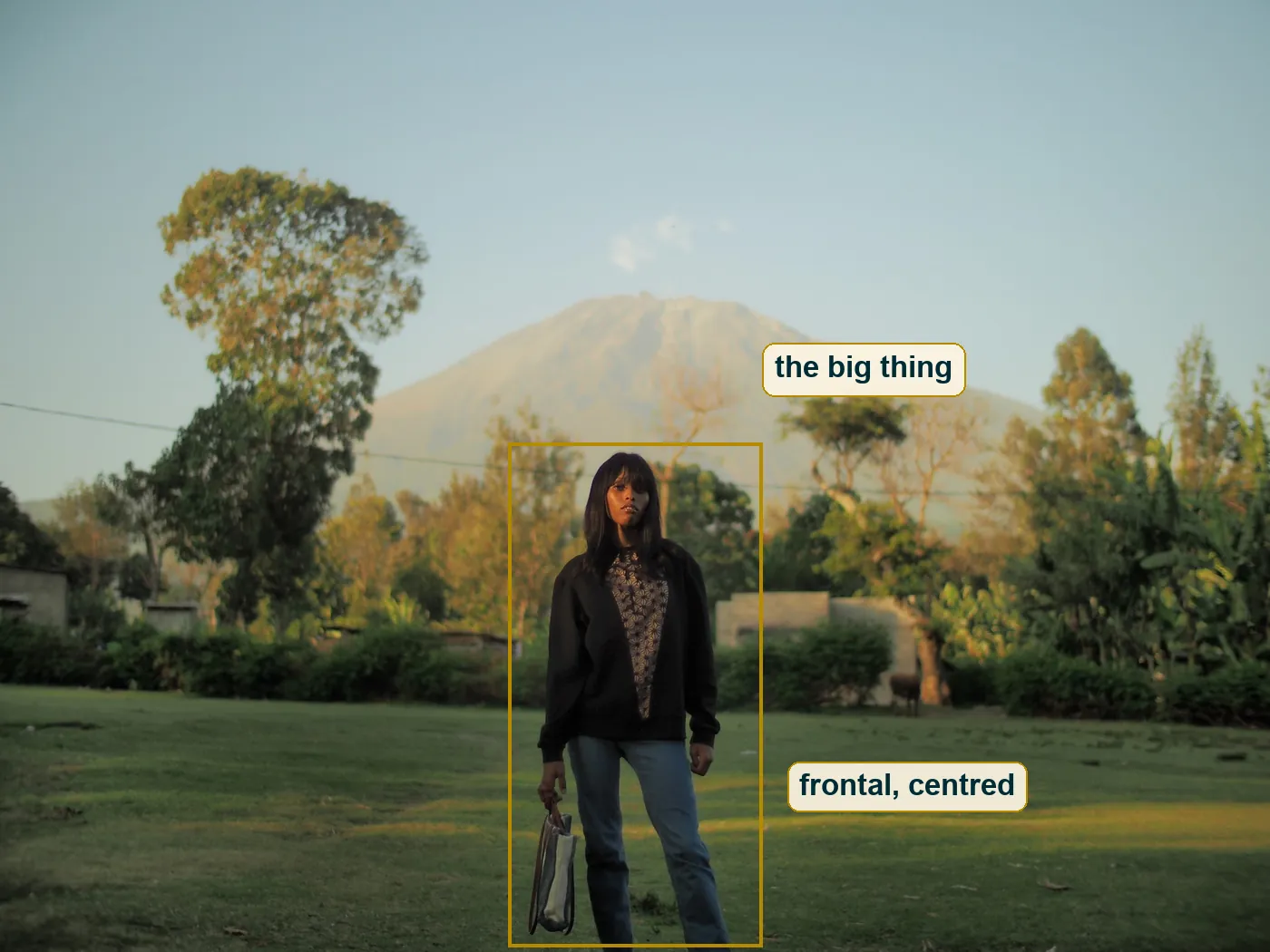
The photographer is Rineke Dijkstra. Her Beach Portraits, made from 1992 to 1994, show young people full length at the water's edge, standing, facing the camera, against a simple sea and sky. Her sitters don't do anything, and the standing becomes the picture. This frame shares that grammar, a frontal person in the centre with a big simple background that dwarfs her without swallowing her. The difference is that Dijkstra keeps the background plain. Here the background is the famous thing, and that pulls in the other root, the holiday snapshot of a person in front of the view. Wang Wei's Departure, translated by Robert Payne, promises green grass again in spring, then asks whether the wanderer will return. The lawn can repeat itself without the person. This frame borrows the tourist's structure and drops the tourist's grin.
The poet is Li Po, also called Li Bai, who lived in Tang China from about 701 to 762. In Zazen on Ching-t'ing Mountain, in Sam Hamill's translation, he sits with a mountain while the birds vanish and the last cloud drains away, until only the mountain is left. The poem and the photo ask the same thing, a person and a mountain in one frame, and who stays. In the poem the person fades into the mountain. In this photo the mountain is huge and still she holds the centre.
The one mistake
The wire. A thin power line crosses the frame from the left edge, sagging a little, and passes behind her head at the brow, between her crown and her eyes.
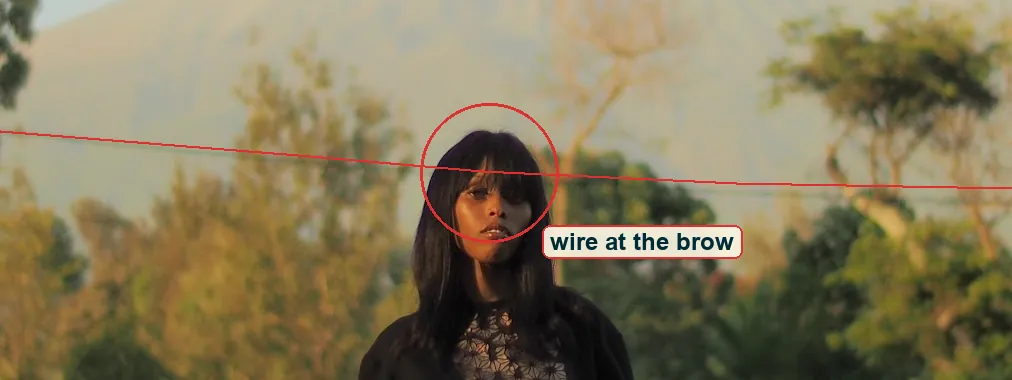
The whole picture builds one vertical line from the summit down to her face, and the wire cuts that line right where it matters most. A sharper lens would not help, it would only draw the wire better.
The fix is height, not a step to the side. The wire runs almost level and lies far behind her, so moving left or right only slides it along. Moving the camera up or down shifts her against it. With her about 4.5 metres away and the wire maybe tens of metres, lifting the camera a hand's width, about 15 cm, moves her down in the frame by about 100 pixels and the wire by about 10. That is enough to clear it above her hair. Crouching is the wrong way, because it pulls the wire down across her eyes. Or clone the wire out later. In a sky this smooth that takes a minute.
Try this
Twenty minutes, one friend, one tall shape.
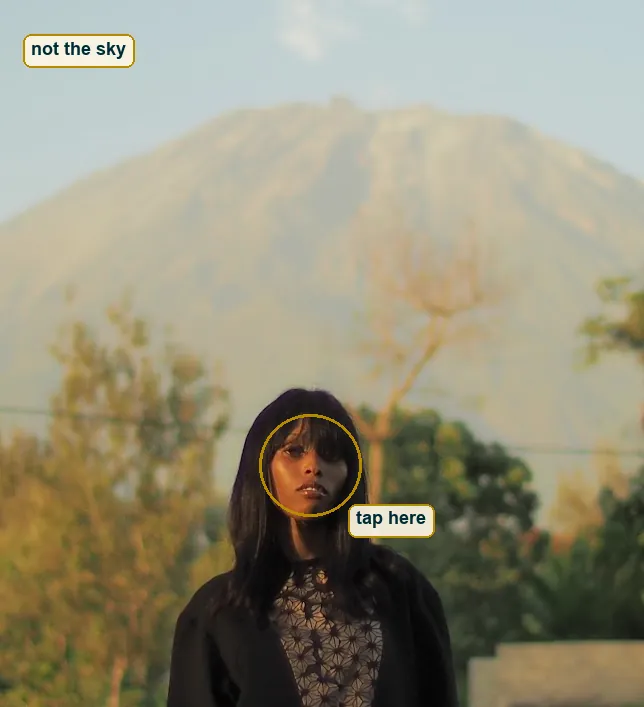
Stand your friend in front of a spire, a tree or a tower, and move your own feet, not theirs, until the top sits exactly over their head. Check head height for wires, then tap on their face to set exposure, not on the sky, and see how much they come forward. Then take the same frame once with the 1x lens from close and once with 2x from further back, and watch the background grow.
Why it stays
The mountain gets the light and she gets the centre, and the picture is the deal between them.
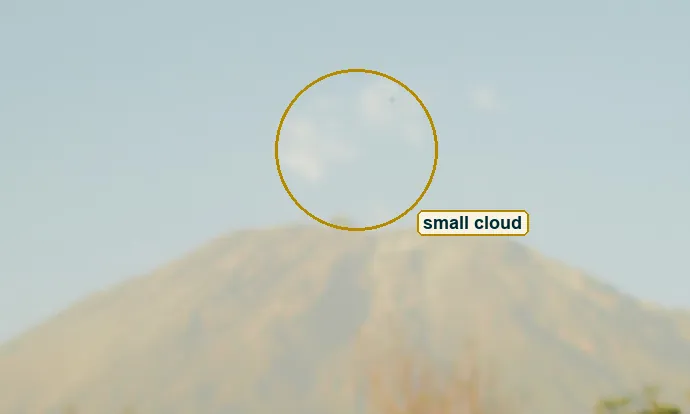
She does not climb the mountain, point at it or grin beside it. She stands square and still and lets it sit on her like a hat she did not ask for. The photographer gave her the middle of the frame and the top of the triangle, and she gives the lens a level look in return. Just over the summit floats one small cloud, the kind Li Po watched drain away. The mountain will be there tomorrow. The cloud, the strip of light on the grass and that exact stacking will not, and that is the part the camera kept.