Cracked lips, neon urine, and two people who took the same pill
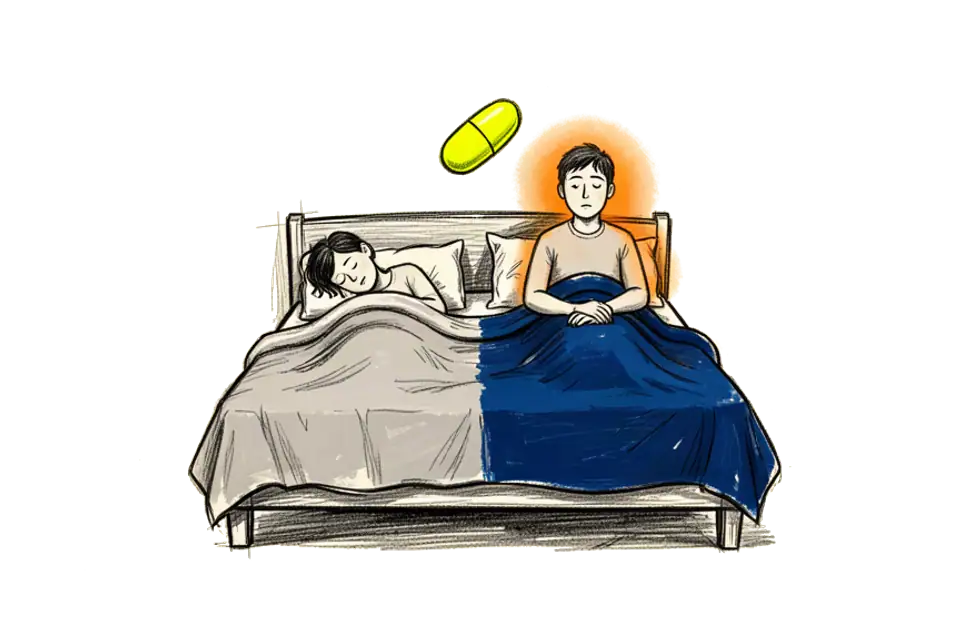
TL;DR: I took a high-dose B supplement, my cracked mouth corner healed and my sleep got better. My partner took the same pill and couldn't sleep at all. The best explanation is baseline status, not the pill: correcting a deficiency helps, excess in someone replete is stimulating. Neon urine only proves riboflavin got absorbed. Next is blood work for both of us before supplementing further.
An accidental n=2 experiment, and what the evidence actually says.
I had cracked mouth corners and couldn't sleep. A pharmacist suspected B-vitamin deficiency. I supplemented. The cracks healed, my urine turned neon yellow, and my sleep got noticeably better. My partner took the same high-dose B supplement. She had no cracked lips. Her sleep got worse, she couldn't sleep at all. Opposite outcomes from the same intervention is the most useful data point in this whole story. It rules out "B vitamins improve sleep" as a general claim. And the literature predicts exactly this split. B12 has a documented alerting effect in healthy subjects, and a 100-person RCT found B-complex made self-rated sleep worse. The largest controlled trial of B12 for delayed sleep phase syndrome found no effect.
The best explanation is that the effect depends on baseline status, not on the pill. Correcting a real deficiency helps. Adding excess to someone already replete is stimulating. A U-shaped curve, not a straight line. The cracked mouth corner is the tell. It's a recognised deficiency sign. I had one and she didn't, and that asymmetry existed before either of us took anything. Neon urine proves nothing except that riboflavin got absorbed. Next is blood work for both of us, before supplementing further. My prediction is that I was low on something and she wasn't.
The setup
I slept badly for weeks. In parallel, one corner of my mouth cracked open and wouldn't heal. The pharmacist's guess was B-vitamin deficiency. I started a high-dose B supplement. Within days the crack healed, my urine went fluorescent yellow, and, unexpectedly, I started sleeping well again.
My partner, watching this, took the same supplement. She did not have cracked lips. Her sleep collapsed. She couldn't fall asleep at all. Two people. One intervention. Opposite results.
Why the n=2 matters more than the n=1
A single person improving after taking something is nearly worthless as evidence. Regression to the mean, placebo, seasonal change and coincidence all explain it equally well.
A discordant pair is different. Same intervention, same household, same timeframe, opposite outcomes. It doesn't tell you the mechanism, but it does something valuable, it kills the simple hypothesis. "B vitamins help you sleep" is now dead. So is "B vitamins keep you awake." Neither survives contact with two opposite outcomes.
What's left is a moderator. Something differed between us that decided the direction of the effect. I ranked the candidates. Baseline deficiency status is the most plausible one, and blood work for both of us tests it. Dose timing, evening vs morning, is medium, and she can just move her dose to breakfast. Which B dominates the formula (B6, B12, niacin) is also medium, and we read the label. Individual sensitivity or genetics is low to medium and not practically testable. Placebo and expectation, because I expected a benefit and she got a surprise, is low to medium and not testable here.
The first one has a visible piece of supporting evidence that predates the supplement. I had a deficiency sign. She didn't.
The mouth corner is the strongest clue
Cracked mouth corners are called angular cheilitis. Most cases are local, like Candida, staph, saliva pooling or contact allergy. But nutritional deficiency accounts for a meaningful share, commonly cited as around a quarter of cases, linked to iron deficiency and to B2 (riboflavin), B3 (niacin), B6 (pyridoxine) and B12 (cobalamin).
The mechanism is boring and plausible. The epithelium at the mouth corners turns over very fast. Take away building blocks or oxygen transport and it atrophies there first. Standard clinical practice is that if antifungal or antibiotic treatment doesn't work within two to three weeks, you test full blood count with MCV, iron studies with ferritin, folate, B2, B6, B12 and fasting glucose.
So the pharmacist was working inside textbook medicine. She was still guessing without a blood value, but she was guessing in the right direction, and the symptom itself is a recognised marker. This is the asymmetry. I had a physical sign of possible deficiency. My partner had none. If baseline status is the moderator, this is the visible evidence for it.
The neon urine proves almost nothing
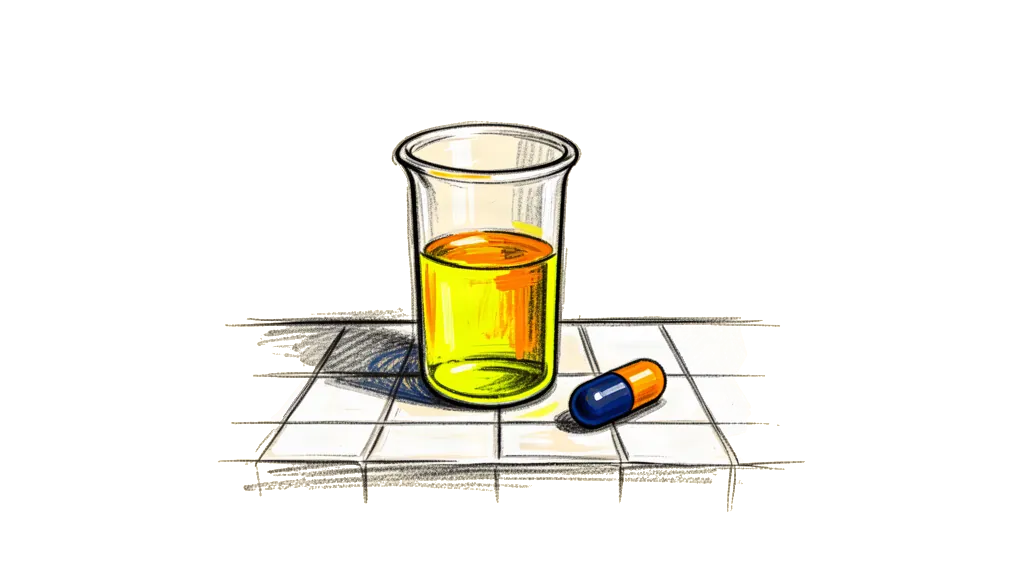
That's excess riboflavin (B2) being excreted by the kidneys. It shows that more B2 arrived than the body could use. It does not show a deficiency existed. It does not show the dose is right. Neon yellow is an absorption signal, not a diagnostic one. And my partner would have had the same neon urine. It tracks intake, not benefit.
The sleep, where the literature gets uncomfortable
My expectation was that B vitamins mean more melatonin and more melatonin means better sleep. The evidence says something else, and in places the opposite.
B12 does measurably act on the circadian clock. In a crossover study with 9 healthy subjects, 3 mg methylcobalamin daily for 4 weeks phase-advanced the 24-hour melatonin rhythm by 1.1 hours, and at the same time it lowered mean melatonin levels. Sleep timing itself didn't change. The authors read it as B12 increasing the light sensitivity of the circadian clock. A second study in 8 men supported this. After B12 a single bright-light exposure produced a significant phase advance, and under placebo it did not. This is a real physiological effect. But it's a timing effect, not a sedative one. A drug that shifts your clock is not a sleeping pill.
And then it turns against the intuition. A German study in healthy subjects found that under methylcobalamin melatonin excretion dropped, night-time activity rose and sleep time was significantly reduced. The authors' conclusion was that B12 has a psychotropic, alerting effect. That is my partner's experience, described in a journal in 1996.
Then the decisive trial. Okawa et al. ran a multicentre, double-blind study in 1997 on 50 patients with delayed sleep phase syndrome, giving 3 mg methylcobalamin over 4 weeks. The result was no significant effect. A systematic review of micronutrients and sleep summarises the B12 literature dryly as mixed effects.
And B6? The popular mechanism is that B6 is a cofactor on the way from tryptophan to serotonin to melatonin. Biochemically correct. Clinically weak. The largest randomised, double-blind, placebo-controlled trial (100 participants, 240 mg B6 before bed, 5 days) found more dream content recalled, but no significant effect on dream vividness, bizarreness, colour, or on any other sleep variable. The important finding is buried in the same paper. The B-complex arm reported significantly worse self-rated sleep quality and significantly more tiredness on waking. That is not a footnote for us. That is the result, in a randomised trial, that matches what happened to my partner.
The model that fits both of us
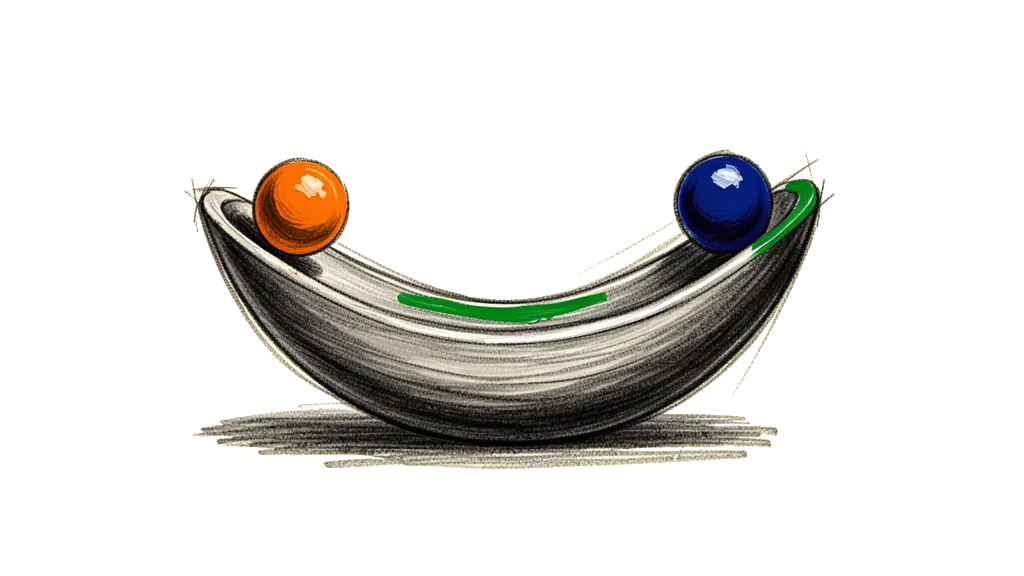
Not a straight line. A U-shape.
sleep
quality
   ▲
   │        ╭─────╮
   │      ╭─╯     ╰─╮
   │    ╭─╯         ╰─╮
   │  ╭─╯             ╰─╮        ← her (pushed right, past optimum)
   │ ╱                   ╲
   └─────────────────────────────▶  B-vitamin status
     deficient   optimal   excess
        ▲
        └── me (moved right, toward optimum)
Same direction of movement along the axis. Opposite effect on sleep, because we started at different points.
This is the standard shape for a nutrient with a therapeutic window, and it is consistent with everything above. Deficiency correction helps and megadosing a replete person is stimulating. That part is an assumption. It's plausible and fits the literature, but it's unproven for our specific case without blood values.
It also explains why the RCTs are "mixed". If you recruit unselected people, you're averaging improvers and worseners. The mean lands near zero. That is exactly what Okawa 1997 found.
Competing explanations I can't rule out
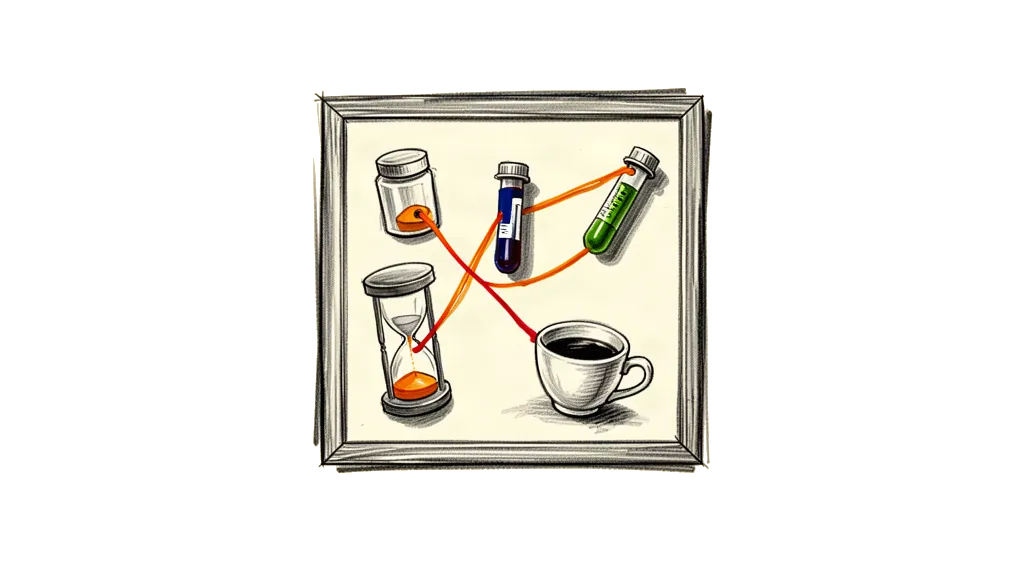
A real deficiency corrected in me only fits my result and hers, and blood work tests it. Her taking the dose too late in the day is neutral for me and fits her, and moving it to the morning tests it. High-dose B6 or niacin specifically fits me partly and her fully, and we read the label. Regression to the mean in me fits my result but not hers, and a washout period tests it. Placebo in me and nocebo in her fits both, and it's not testable here.
Honest position. I have no baseline blood values, so my own case is not evaluable. That is the core weakness of self-experiments. The discordant pair narrows the field but does not close it.
What we do next
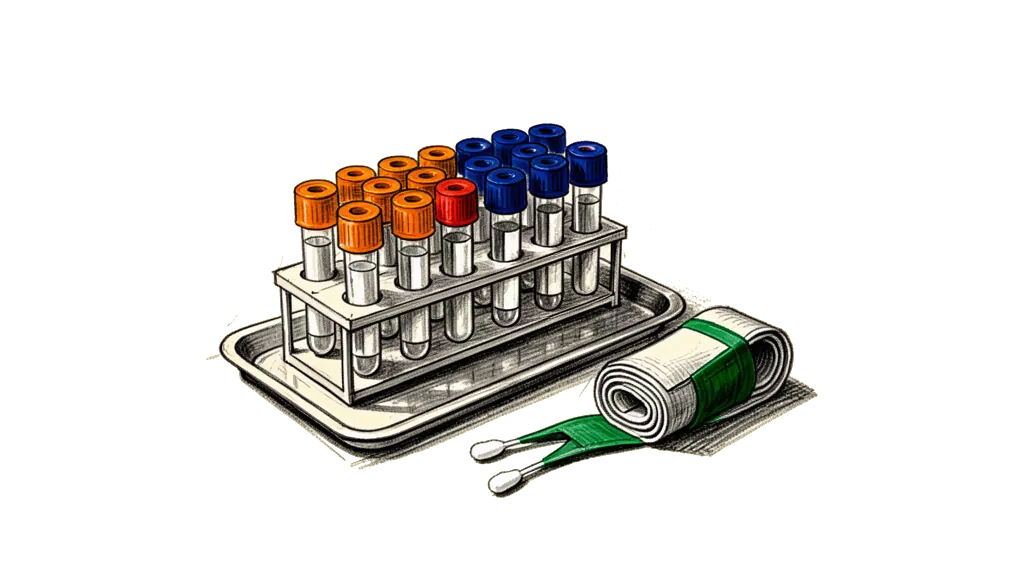
First, blood work for both of us, now, before supplementing further. Supplements distort the values, so test first. We want a full blood count plus MCV to classify any anaemia, ferritin plus transferrin saturation for iron deficiency and restless-legs risk, vitamin B12 plus holotranscobalamin because serum B12 alone is unreliable, methylmalonic acid (MMA) for functional B12 status, folate for differential diagnosis, zinc because it's a frequently missed cause of cracked mouth corners, and fasting glucose as the standard exclusion in angular cheilitis.
My prediction, stated in advance so it can be wrong, is that I come back low on at least one of iron, B12 or folate and she comes back normal or high. If we both come back normal, the deficiency-correction model is falsified and the answer is placebo, timing, or something else entirely.
Second, she stops, or moves the dose to the morning. If a supplement is causing insomnia, the fix is not persistence. Lower the dose, take it at breakfast, or stop until the blood work is back. There is no argument for pushing through.
Third, check the B6 dose specifically. Prolonged high-dose B6 can cause peripheral neuropathy. This is not a hypothetical risk. Both of us read the label and check the actual milligrams against the RDA.
Fourth, a washout as a control on me. After the blood work I go 3 to 4 weeks off and track sleep. If the mouth corner returns and sleep degrades, the deficiency hypothesis gains ground. If nothing happens, it was regression or placebo.
Fifth, adjust expectations. If my values come back normal, B vitamins are not the answer and never were. Then the cause is elsewhere, like timing, light exposure, alcohol or breathing. At that point the useful next tool is a sleep tracker with SpO₂, not another pill.
Sources
Angular cheilitis
- Angular Cheilitis, StatPearls, NCBI Bookshelf, aetiology, deficiency patterns, testing cascade. https://www.ncbi.nlm.nih.gov/books/NBK536929/
- Angular cheilitis induced by iron deficiency anemia, Cleveland Clinic Journal of Medicine 2018;85(8):581. https://www.ccjm.org/content/85/8/581
B12 and circadian rhythm
- Honma K et al., Effects of vitamin B12 on plasma melatonin rhythm in humans, Experientia 1992;48(8):716–720. https://link.springer.com/article/10.1007/bf02124286
- Uchiyama M et al., Vitamin B12 enhances the phase-response of circadian melatonin rhythm to a single bright light exposure in humans, Neuroscience Letters 1996. https://www.sciencedirect.com/science/article/abs/pii/S030439409613247X
The alerting effect, relevant to her case
- Mayer G, Kröger M, Meier-Ewert K, Effects of vitamin B12 on performance and circadian rhythm in normal subjects, Neuropsychopharmacology 1996;15:456–464. Sleep time significantly reduced under methylcobalamin. https://pubmed.ncbi.nlm.nih.gov/8914118/
The null result
- Okawa M et al., Vitamin B12 treatment for delayed sleep phase syndrome: a multi-center double-blind study, Psychiatry and Clinical Neurosciences 1997;51(5):275–279. https://pubmed.ncbi.nlm.nih.gov/9413873/
- The relationship between micronutrient status and sleep patterns: a systematic review, Public Health Nutrition, Cambridge University Press. https://www.cambridge.org/core/journals/public-health-nutrition/article/relationship-between-micronutrient-status-and-sleep-patterns-a-systematic-review/4A45D9B9BE7BC1644AB307CAB6877519
B6, dreams, and the B-complex finding
- Aspy DJ, Madden NA, Delfabbro P, Effects of Vitamin B6 (Pyridoxine) and a B Complex Preparation on Dreaming and Sleep, Perceptual and Motor Skills 2018. B-complex group reported worse sleep quality. https://journals.sagepub.com/doi/10.1177/0031512518770326
- Field DT et al., High-dose Vitamin B6 supplementation reduces anxiety and strengthens visual surround suppression, 2022, evidence that high-dose B6 acts on GABAergic inhibition. https://www.ncbi.nlm.nih.gov/pmc/articles/PMC9787829/
Not medical advice. I'm not a doctor. This is a documented self-experiment with its sources attached and its weaknesses stated. If you have cracked mouth corners and bad sleep, get blood work instead of guessing, myself included.