Could the shape of randomness help explain why matter won?
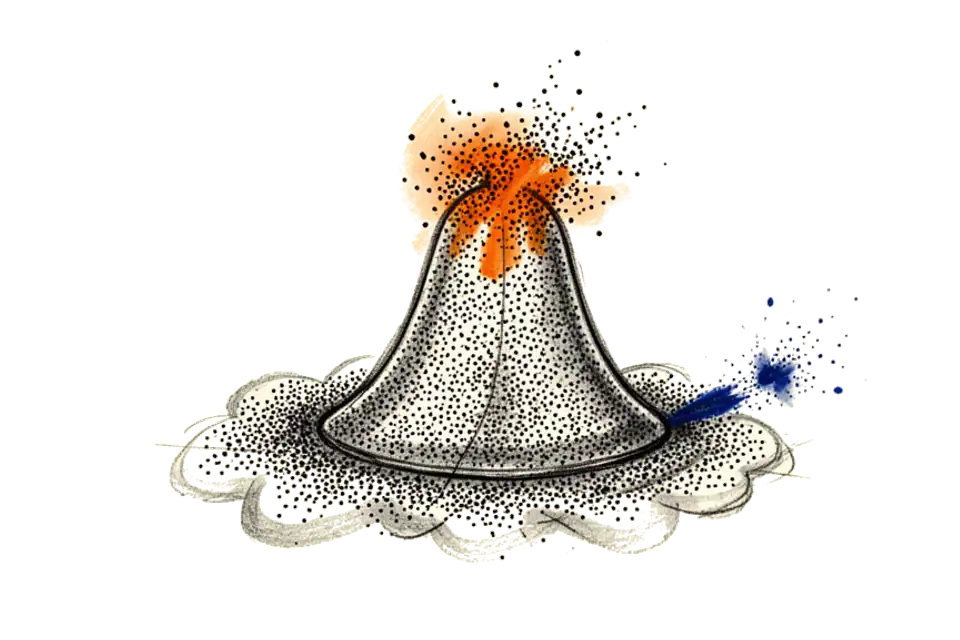
TL;DR: Matter beat antimatter by roughly one particle per billion, and current physics can't yet explain how that tiny edge got big enough. My idea: the Boltzmann peak isn't matter, it may be the amplifier where a tiny matter advantage gets strong. Radiation could be the middle step in a loop of annihilation and pair creation, until freeze-out locks the leftover in. It's a question for research, not a finished theory, and I list the serious problems with it.
I want to put an idea out there for a research conversation, about Boltzmann statistics, radiation, matter, antimatter and the early universe. I'm not saying it's proven. I'm not saying current physics is wrong, and I'm not saying I solved the matter and antimatter problem.
I'm just saying there may be a link worth talking about. Maybe the imbalance between matter and antimatter isn't only about a tiny difference at the start. Maybe it's also about how randomness spreads itself out.
The mystery

The mystery itself is famous. In the early universe matter and antimatter should have been made together, and when they meet they annihilate. If the balance had been perfect, almost everything would have turned into radiation. But that's not what we see. We see galaxies and stars and planets and us.
CERN describes the puzzle as a tiny excess of matter, roughly one extra matter particle per billion antiparticles, that survived the annihilation and became everything we see today. So almost everything cancelled out, and the tiny bit that was left became the universe we live in. That alone is crazy.
Randomness makes shapes
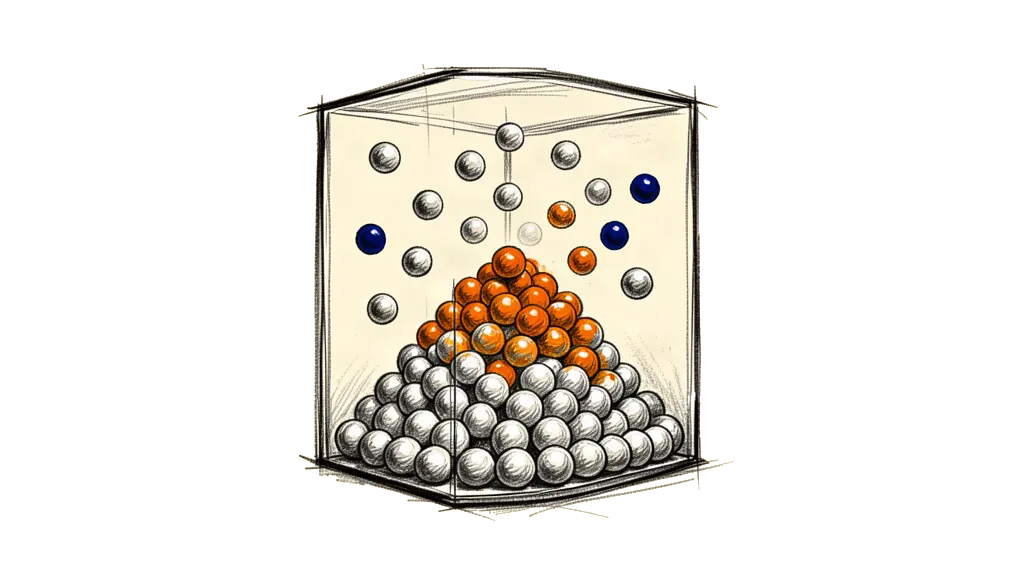
My question starts there. When particles collide at random, what you get isn't pure disorder. Randomness can make structure. In a gas, random motion leads to the Maxwell-Boltzmann distribution, a speed distribution you can predict, with a clear peak and a long tail.
OpenStax describes it as the predictable speed distribution of many molecules that move at random. That shape is what I find interesting.
My first thought was simple. Max peak = matter? Maybe the most likely part of the distribution, the peak, where most things happen, somehow ends up as the matter side. But I know that can't be taken literally.
Matter and antimatter aren't just slow particles and fast particles. They're particle and antiparticle partners, and a proton and an antiproton aren't different because of speed. CERN's BASE experiment even found the charge to mass ratios of the proton and the antiproton equal within 16 parts per trillion, and that strongly supports the idea that matter and antimatter have the same basic properties under the physics we know.
So I want to make the idea better. Maybe the peak isn't matter. Maybe the peak is the amplifier. The Boltzmann distribution doesn't pick matter by itself. But if there's even a tiny rule somewhere that favors matter, a tiny asymmetry in decay or scattering or interaction or freeze-out, then the shape of the distribution could matter a lot.
Because most particles and most events sit near the peak and not far out in the tail, a tiny asymmetry near the peak could have a much bigger effect than the same asymmetry in a rare part of the curve. So the better version is this.
The peak isn't matter. The peak is where a tiny matter advantage could get strong in the statistics.
Where this meets real physics

This links to physics that already exists. People study the matter and antimatter problem through baryogenesis and leptogenesis. A classic starting point is Sakharov's idea from 1967 that a universe with more matter than antimatter needs some ingredients, namely matter number violation, C and CP violation, and a departure from thermal equilibrium.
CERN Courier describes the current searches around these Sakharov conditions, including CP violation, baryon and lepton number violation and physics out of equilibrium. That's already close to where my head goes. Not just particles but processes, not just symmetry but symmetry breaking, not just equilibrium but the moment equilibrium fails.
CERN's LHCb experiment recently saw CP violation in a baryon decay. That means a matter particle and its antimatter partner didn't behave like perfect mirror images in that decay. The asymmetry they measured was about 2.45%, with a significance of 5.2 standard deviations. CERN also says that the CP violation we know today in the Standard Model is still far too small to explain the extra matter in the cosmos.
So there's a real direction here. Tiny differences between matter and antimatter exist, but we still don't know how the universe made them big enough.
That's where I want to bring in Boltzmann thinking. Maybe the question shouldn't only be where the tiny bias came from. Maybe we should also ask how the statistical shape of the early universe made that tiny bias bigger, kept it, or wiped it out.
The Boltzmann equation is already used in this research. The classic paper by Kolb and Wolfram on baryon number generation in the early universe used it to work out how an excess of baryons over antibaryons could build up over time.
Newer papers study full Boltzmann equations for leptogenesis, sometimes without assuming kinetic equilibrium, and show that the details of the distribution can change the final asymmetry. That's important for my idea, because I'm not only interested in the total number of particles.
I'm interested in the shape of the distribution, where most events happen and where rare events happen, and how a tiny rule could get bigger depending on where it acts.
There's also research on CP violating scatterings. Nardi, Racker and Roulet studied Boltzmann equations that include decay and scattering and computed CP violating scattering asymmetries. Baldes and his co-authors studied CP violating scatterings in baryogenesis and found that scatterings can play the main role in part of the parameter space.
That's very close to what I'm trying to say. Collisions aren't just noise. Under the right conditions they may help shape the imbalance that's left at the end.
Radiation is not nothing
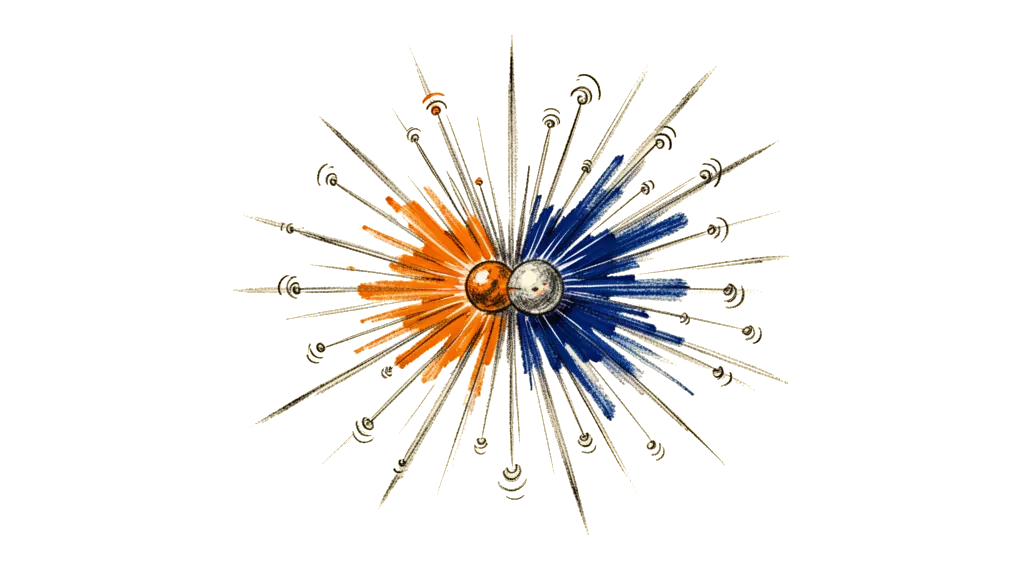
Now I want to add radiation. When people say matter and antimatter annihilate and leave only radiation, the word only can mislead you. Radiation isn't nothing. It carries energy and momentum and sometimes subtle correlations. Fermilab describes matter and antimatter annihilation as making photons or gamma rays, and an electron and a positron usually annihilate into two gamma ray photons.
So maybe we shouldn't think of annihilation as plain destruction but as a change of form. Matter + antimatter become radiation.
And radiation can turn into matter again if the energy is high enough. Brookhaven reported evidence for the Breit-Wheeler process, where collisions of light make pairs of matter and antimatter, and the DOE describes it as making matter and antimatter from collisions of real photons.
That doesn't mean radiation makes matter alone. Normally radiation makes matter and antimatter together. But it does hint at a kind of recycling.
matter + antimatter → radiation → matter + antimatter again
In the early universe, when everything was super hot and dense, this loop may have been part of the system. Particles annihilate into radiation, radiation makes pairs, collisions spread the energy around, expansion cools everything down, and at some point some processes just stop. Physicists call that stopping freeze-out. So my bigger idea is that the early universe maybe wasn't a one time matter against antimatter event.
Maybe it was a recycling system of particles, antiparticles, radiation, collisions, pair creation, annihilation and freeze-out. And in that system radiation isn't the trash at the end. It's part of the engine.
Black holes and information

This also makes me think about black holes. Black hole radiation isn't the same thing as matter and antimatter annihilation. Hawking radiation is a quantum effect where black holes give off particles as if they had a temperature, and Hawking's classic paper from 1975 showed that quantum effects make black holes emit particles like hot bodies.
But black holes are interesting here for another reason, and that's information. The black hole information problem asks if information gets destroyed or kept when black holes radiate. Newer work on Hawking radiation, the Page curve and islands suggests that the information may be stored in subtle correlations in the radiation, at least in some theoretical models.
So maybe radiation shouldn't be treated as just leftover heat. Maybe it's a carrier layer. Maybe in the early universe radiation carried energy and structure and maybe correlations through many rounds of annihilation and pair creation. Again, that alone doesn't explain why matter wins, because radiation normally makes matter and antimatter together.
We still need a tiny asymmetry somewhere. But radiation could be the middle step, and the Boltzmann distribution could be the statistical amplifier. So the full picture looks like this.
random collisions → Boltzmann-shaped distribution → annihilation → radiation → pair creation → tiny asymmetry → freeze-out → leftover matter
It's not a finished theory. It's a direction for research. The strongest version goes like this. The extra matter in the universe may not come only from a tiny asymmetry at the micro level. It may also depend on where that asymmetry acts inside the statistical distribution of the early universe.
If it acts near the peak, where most particles and interactions are, it could get much more important. If it only acts in the tail, it may do a lot less. That's why the max peak still feels important to me.
Not because the peak really means matter, but because the peak may be the place where the tiny advantage of matter becomes visible.
A machine on a table

I think you could explore this with a simple mechanical model. Imagine a device on a table with lots of small balls. The balls get shaken at random, they collide and they leave at different speeds, and their speed sorts them into different bins, like a mechanical Maxwell-Boltzmann demonstrator.
Now use two colors. White balls are matter and black balls are antimatter.
First you run a control test where the machine is totally color blind. Same ball size, same weight, same material, same rules. If everything is really symmetric, the machine shouldn't give you a stable excess of white or black.
It can give random swings but no winner you can repeat. That's important, because it would show that the shape of the distribution alone doesn't magically pick matter.
Then you add a tiny controlled bias, a mechanical version of a CP like asymmetry. For example a tiny difference in how balls near the peak speed get routed or kept. Then you add an annihilation stage where a white ball and a black ball can remove each other.
And the question becomes if a tiny bias near the peak leaves a much bigger visible excess after many rounds than the same tiny bias in the tail. If yes, the device wouldn't prove that the universe works exactly like this. But it would show the principle.
random collisions + peaked distribution + tiny asymmetry + annihilation = visible leftover imbalance
That's the core of the intuition. And I find it interesting because it ties together real pieces of physics. Random collisions make distributions. Matter and antimatter almost cancel. Tiny CP violating differences exist. Boltzmann equations are already used in baryogenesis. Full distributions can matter and not only total particle counts.
Annihilation makes radiation, and radiation can later make particle and antiparticle pairs. And freeze-out can keep a leftover imbalance. It also gives you a picture for the matter and antimatter problem. Instead of seeing the early universe as a coin toss between matter and antimatter, you can see it as a system that moves, a sea of collisions, radiation, pair creation, annihilation and statistical filtering.
In that sea a tiny asymmetry might not count the same everywhere. It may count most where the distribution is densest.
The serious problems
There are serious problems. First, the Maxwell-Boltzmann curve alone can't pick matter. A speed distribution isn't a label for matter or antimatter, and matter and antimatter partners should have the same speed distribution if they have the same mass and sit in the same thermal environment.
Second, radiation normally makes matter and antimatter together, so radiation alone can't explain a net excess of matter. Third, a color blind machine shouldn't make a stable color excess. If it does, there's probably a hidden bias in the machine.
Fourth, big domains of matter and antimatter close to us are strongly constrained. Cohen, De Rujula and Glashow argued that a patchwork universe of matter and antimatter would make annihilation signals at the borders, including effects in gamma rays and in the cosmic microwave background, and they concluded that a matter and antimatter symmetric universe is ruled out by the data unless our matter domain is basically the whole visible universe.
CERN Courier also reported in 2026 that observations of the diffuse gamma ray background and the cosmic microwave background show no evidence for antimatter on large scales and rule out a matter and antimatter symmetric universe in the region we can observe.
So the idea shouldn't be "the Boltzmann peak is matter". The stronger idea is "Boltzmann shaped collision statistics may amplify a tiny asymmetry that favors matter, especially if that asymmetry acts near the most crowded part of the distribution". That's a lot more careful and a lot more interesting.
In one sentence, maybe matter won not only because there was a tiny bias at the micro level, but because the statistical shape of the early universe made that bias bigger in the right place, before annihilation and freeze-out locked in the leftover matter.
What I want to try next

I'd like to explore this in three ways. First with a simple simulation where particles get created, annihilate, scatter and freeze out, to test if a tiny bias near the peak of the distribution leaves a bigger surviving excess than the same bias in the tail.
Second with the mechanical model on the table, where random shaking makes a speed distribution, two colors stand for matter and antimatter, a tiny controlled bias gets added, an annihilation stage removes pairs and you measure the imbalance that's left. And third with a bridge to the literature, to compare this intuition with the work that already exists on Boltzmann equations, CP violating scatterings, leptogenesis, baryogenesis, freeze-out, physics out of equilibrium, and radiation and information.
I'm not putting this out as a conclusion. I'm putting it out as a question. Did matter win only because of a tiny asymmetry at the micro level, or also because the statistical shape of the early universe made that asymmetry bigger in the right place?
Could the shape of randomness be part of why matter won?
Sources
Here are the sources, if you want to read more.
Background on antimatter and the cosmic puzzle. CERN, Antimatter. CERN, The matter–antimatter asymmetry problem. CERN Courier, Exploring the origins of matter–antimatter asymmetry. CERN Courier, All that antimatters in the universe.
The Maxwell-Boltzmann distribution and statistical mechanics. OpenStax, Distribution of Molecular Speeds, Maxwell–Boltzmann distribution. Khan Academy, What is the Maxwell–Boltzmann distribution?. David Tong, Cosmology notes, thermal distributions and chemical potentials.
The first papers and reviews on baryogenesis. Sakharov, Violation of CP Invariance, C Asymmetry, and Baryon Asymmetry of the Universe. Sakharov original paper listing, OSTI. Kolb & Wolfram, Baryon Number Generation in the Early Universe. Kolb & Wolfram PDF. Kolb & Wolfram, The Development of Baryon Asymmetry in the Early Universe. James Cline, Baryogenesis. Antonio Riotto, Theories of Baryogenesis. Björn Garbrecht, Why is there more matter than antimatter?. Davidson, Nardi & Nir, Leptogenesis.
Boltzmann equations, full distributions and leptogenesis. Enomoto, Su, Zheng & Zhang, Boltzmann Equation and Its Cosmological Applications, and the published version. Hahn-Woernle, Plumacher & Wong, Full Boltzmann equations for leptogenesis including scattering. Garayoa, Pastor, Pinto, Rius & Vives, On the full Boltzmann equations for Leptogenesis. Nardi, Racker & Roulet, CP violation in scatterings, three body processes and the Boltzmann equations for leptogenesis. Baldes, Bell, Millar, Petraki & Volkas, The role of CP violating scatterings in baryogenesis. Kainulainen, CP-violating transport theory for Electroweak Baryogenesis with thermal corrections.
Freeze-out, annihilation and baryogenesis linked to dark matter. Yanou Cui, A Review of WIMP Baryogenesis Mechanisms. Bernal, Colucci, Josse-Michaux, Racker & Ubaldi, On baryogenesis from dark matter annihilation. Cui & Sundrum, A WIMPy Baryogenesis Miracle.
Other statistical distributions and related speculative directions. Dehpour, Thermal leptogenesis in nonextensive cosmology. Dehpour, Thermal leptogenesis in anisotropic cosmology.
Experiments at CERN that test matter against antimatter. CERN, A new piece in the matter–antimatter puzzle, LHCb CP violation in baryon decay. LHCb paper, Observation of charge-parity symmetry breaking in baryon decays. CERN, BASE breaks new ground in matter–antimatter comparisons. Nature, 16-parts-per-trillion measurement of antiproton-to-proton charge-to-mass ratio. CERN, ALPHA experiment observes influence of gravity on antimatter. Nature, Observation of the effect of gravity on the motion of antimatter.
Radiation, annihilation and matter from light. Fermilab, What is annihilation?. Fermilab, Electron–positron annihilation and gamma rays. Symmetry Magazine, What is annihilation?. Brookhaven, Collisions of Light Produce Matter/Antimatter from Pure Energy. DOE, Making Matter from Collisions of Light. OSTI version, Making Matter from Collisions of Light.
Cosmic radiation and the CMB. ESA, Cosmic Microwave Background radiation. ESA, Planck and the cosmic microwave background. NASA WMAP overview.
Domains of matter and antimatter, the question of two regions. Cohen, De Rujula & Glashow, A Matter-Antimatter Universe?, and the PDF. von Ballmoos, Antimatter in the Universe, Constraints from Gamma-Ray Astronomy.
Black hole radiation and information. Hawking, Particle Creation by Black Holes, with the DOI link and the Caltech record. Almheiri, Hartman, Maldacena, Shaghoulian & Tajdini, The entropy of Hawking radiation. Replica Wormholes and the Entropy of Hawking Radiation. Replica Wormholes and the Black Hole Interior. Raju, Lessons from the Information Paradox.
Speculative ideas around black holes and antimatter. Popławski, Spinors with torsion and matter–antimatter asymmetry. Popławski, Matter–antimatter asymmetry and dark matter from torsion. Baryon asymmetry, dark matter, and density perturbation from primordial black holes. Gravitational baryogenesis and dark matter from primordial black holes.